12 Best AI Tools for Marketing to Boost ROI in 2025

In today’s competitive market, staying ahead means embracing smarter, more efficient strategies. As someone who advises other SEO agencies on achieving tangible ROI, I’ve seen first-hand how artificial intelligence has shifted from a futuristic concept to a daily necessity. The right AI tools for marketing can revolutionise everything from prospecting and content creation to detailed analytics and customer engagement, solving the persistent challenge of scaling personalised efforts without exhausting resources.
This guide is designed to cut through the noise. I will walk you through 12 of the most powerful platforms I’ve personally tested and implemented, from established players like HubSpot to specialised tools like Clay and Surfer SEO. My goal is to move beyond generic feature lists and provide a strategic resource that helps you make informed decisions for your specific needs, whether you’re a freelancer, a small business owner, or part of a larger marketing team.
Inside, you will find an honest assessment of each tool, complete with:
- Real-world use cases based on my own experiences.
- An analysis of key features, pros, and cons.
- Practical implementation tips to get you started.
- Clear screenshots and direct links to explore each platform yourself.
This isn’t just another list; it’s a practical playbook for integrating AI into your marketing workflow to achieve genuine, measurable results. Let’s explore the tools that will help you work smarter, not harder.
1. Clay: Revolutionising The Prospecting Process
Clay stands out as a premier AI tool for marketing, specifically engineered to redefine and automate the often-gruelling process of sales prospecting. Where many platforms offer fragmented solutions, Clay provides a cohesive, end-to-end system that integrates data aggregation, enrichment, and AI-driven analysis into a single, powerful workflow. It moves beyond simple lead lists by creating dynamic, intelligent pipelines that empower sales and marketing teams to connect with the right people at the right time with unparalleled precision.
This platform’s core strength lies in its ability to connect over 50 data providers, including LinkedIn, Google, and Clearbit, allowing you to build comprehensive prospect profiles from scratch. The AI, which Clay calls its “waterfall” model, sequentially queries these sources until it finds the required information, ensuring you only pay for successful data retrieval. This makes it an incredibly efficient and cost-effective solution for building highly targeted outreach campaigns. According to a case study by the prospecting agency ‘lemlist’, using such enriched data can increase reply rates by up to 25%.
Key Features and Use Cases
Clay excels at transforming raw data into actionable outreach. Its AI web scraper, Claygent, can browse websites to find specific information, such as identifying key personnel or summarising a company’s recent case studies to use for personalisation.
- Data Aggregation and Enrichment: Automatically pull and combine data from dozens of sources to build a complete picture of each prospect. For example, I can start with a list of company domains and use Clay to find the Head of Marketing, their LinkedIn profile, and their company’s latest funding announcement.
- AI-Powered Personalisation: Leverage AI to analyse gathered data and generate hyper-personalised email opening lines or outreach angles. I find this feature invaluable for breaking through the noise and making a genuine connection.
- Intelligent Lead Filtering: Use complex logic to find prospects that meet very specific criteria, far beyond what standard sales tools offer. You could, for instance, find companies that recently hired a new CMO and use a specific tech stack.
Practical Implementation and Considerations
Getting started with Clay does involve a learning curve, especially for mastering its more advanced workflow automations. However, its template library provides excellent starting points for common use cases. I recommend beginning with a simple project, like enriching a list of 100 conference attendees, to familiarise yourself with the interface before scaling up.
Pros:
- Automates and accelerates lead discovery, drastically reducing manual research time.
- Integrates multiple data sources for truly comprehensive prospect profiles.
- The user interface is intuitive for building complex, logical workflows.
- Enhances ROI by ensuring marketing efforts are focused on high-quality, relevant leads.
Cons:
- The depth of its features requires a learning period to fully leverage.
- Best suited for professionals already familiar with sales prospecting concepts.
For access and pricing details, visit the official website. Clay offers tiered plans based on usage credits, which provides flexibility for teams of all sizes.
Website: https://mersudinforbes.com/tools/clay-revolutionising-the-prospecting-process/
2. HubSpot Marketing Hub
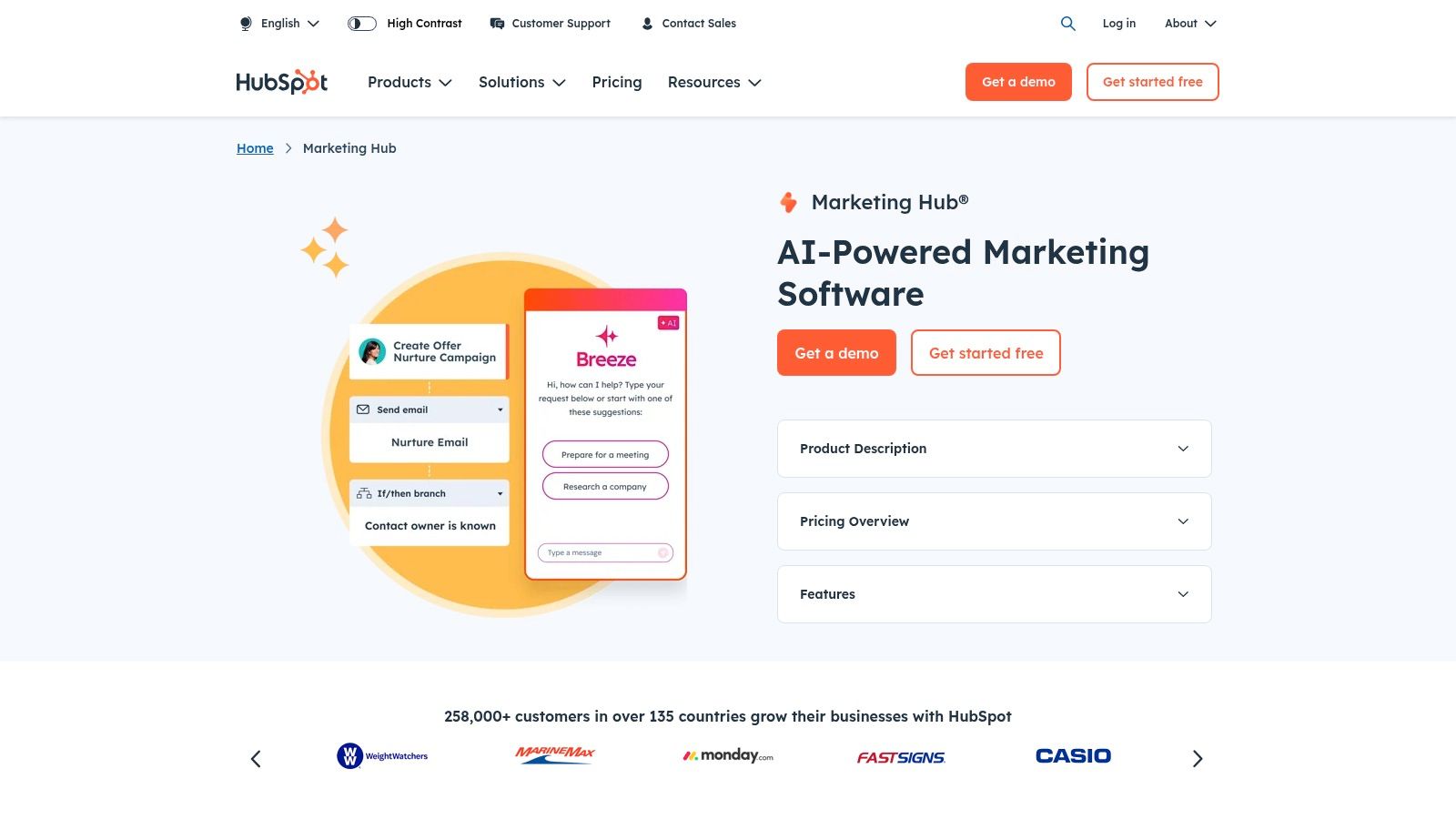
HubSpot’s Marketing Hub stands as a titan in the marketing world, offering an all-in-one platform where its AI features are deeply integrated rather than just bolted on. Its strength lies in using artificial intelligence to streamline and enhance core marketing activities, making it one of the most comprehensive AI tools for marketing available. The platform’s AI assists with everything from drafting blog posts and social media copy to optimising email send times and predicting customer behaviour, all within a unified ecosystem connected to its powerful CRM.
Key Features & Use Cases
What truly sets HubSpot apart is how its AI functions work together. For instance, you can use the AI assistant to generate a blog topic, draft the article, create promotional social posts, and then design an email campaign to distribute it. The platform’s analytics will then track performance, providing AI-powered insights to refine future strategies. This holistic approach helps marketers connect disparate activities, such as linking content performance directly to lead generation and sales. The AI can also help manage complex automated workflows, making sophisticated strategies like programmatic advertising more accessible within a broader inbound marketing plan. A practical example is using its ‘Predictive Lead Scoring’ feature to automatically prioritise high-value leads for the sales team, as highlighted in their own customer success stories.
Pricing and Accessibility
HubSpot offers a tiered pricing structure, starting with a limited free plan. Paid plans are:
- Starter: From £15/month
- Professional: From £660/month
- Enterprise: From £3,000/month
While the initial cost for higher tiers is significant, the value comes from its scalability and extensive feature set. The user-friendly interface is a major plus, though mastering its more advanced automation and reporting tools requires dedication. HubSpot supports this with one of the most extensive libraries of free educational resources and certifications in the industry.
- Pros: All-in-one platform with a powerful CRM, excellent educational resources, user-friendly design.
- Cons: Can become expensive quickly, advanced features have a steep learning curve.
- Website: hubspot.com/products/marketing
3. Mailchimp
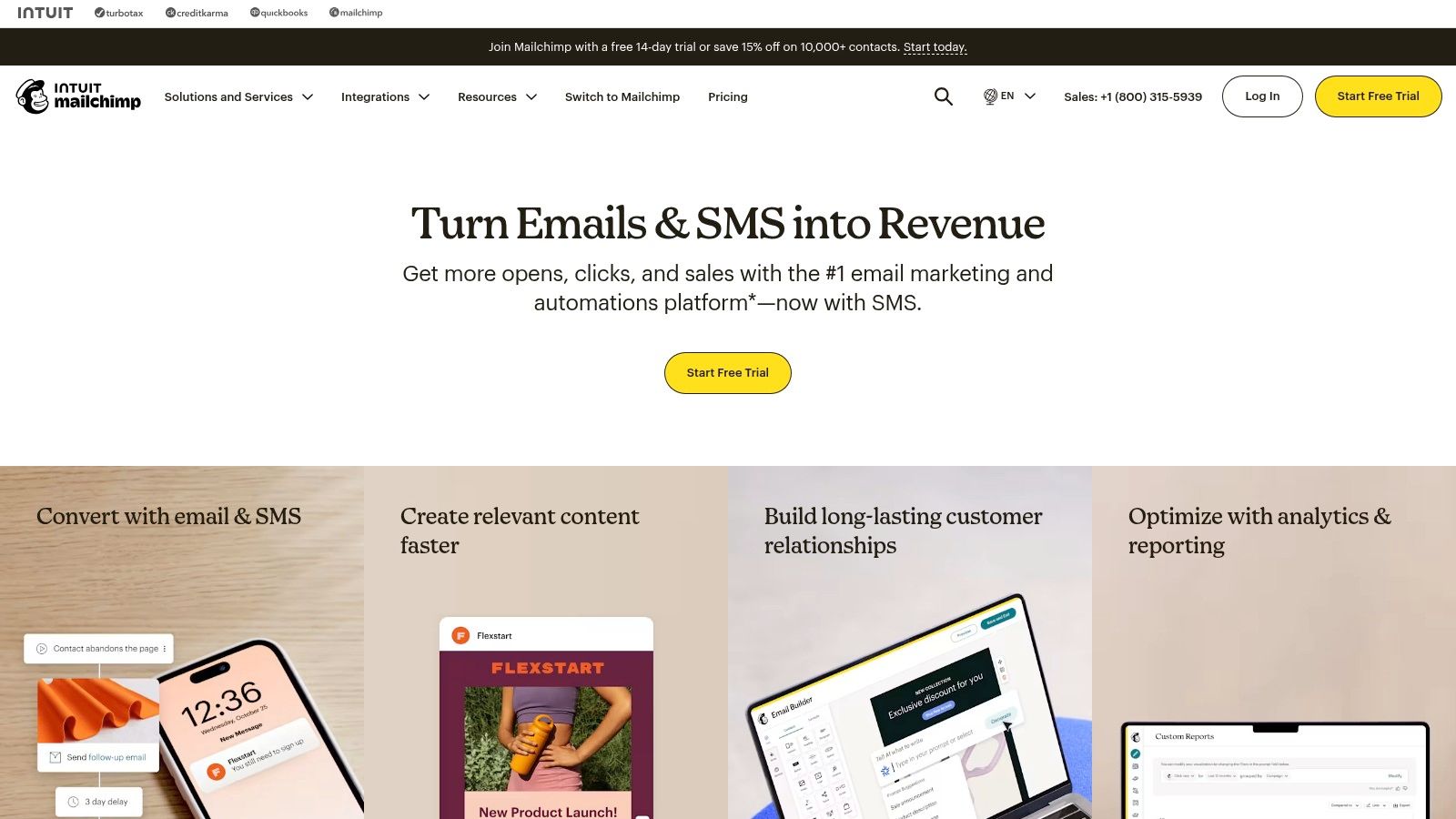
Mailchimp has evolved far beyond its origins as a simple email newsletter service, now positioning itself as a powerful marketing platform with AI at its core. It excels at making sophisticated email marketing accessible, using artificial intelligence to help businesses create, send, and analyse campaigns more effectively. The platform’s AI-driven features provide intelligent recommendations on audience segmentation, content creation, and send-time optimisation, making it one of the most user-friendly AI tools for marketing, especially for small to medium-sized businesses.
Key Features & Use Cases
Mailchimp’s AI is designed for practical application. For example, its Creative Assistant can pull brand assets directly from your website to generate on-brand designs for emails and social posts automatically. The platform’s predictive analytics also help identify which audience segments are most likely to make a purchase, allowing you to create highly targeted campaigns. I find the AI-powered Content Optimiser particularly useful; it analyses millions of data points from top-performing campaigns in your industry to provide specific suggestions for improving your subject lines, headlines, and body copy for better engagement. For instance, it might suggest adding an emoji to a subject line for a B2C campaign, a tactic that data from providers like Campaign Monitor shows can increase open rates by 56%.
Pricing and Accessibility
Mailchimp offers a tiered model that caters to businesses at different growth stages.
- Free: Up to 500 contacts with basic features.
- Essentials: From £11/month.
- Standard: From £17/month.
- Premium: From £250/month.
The platform is renowned for its intuitive and clean interface, making it easy for beginners to get started. While the free plan is generous, more advanced AI features like predictive segmentation and send-time optimisation are reserved for paid tiers. The pricing can become a significant consideration as your contact list grows, so it’s important to factor that into your budget.
- Pros: Highly intuitive interface, strong automation capabilities, comprehensive free plan.
- Cons: Pricing can escalate with list growth, advanced AI features are limited to higher-tier plans.
- Website: mailchimp.com
4. Jasper.ai
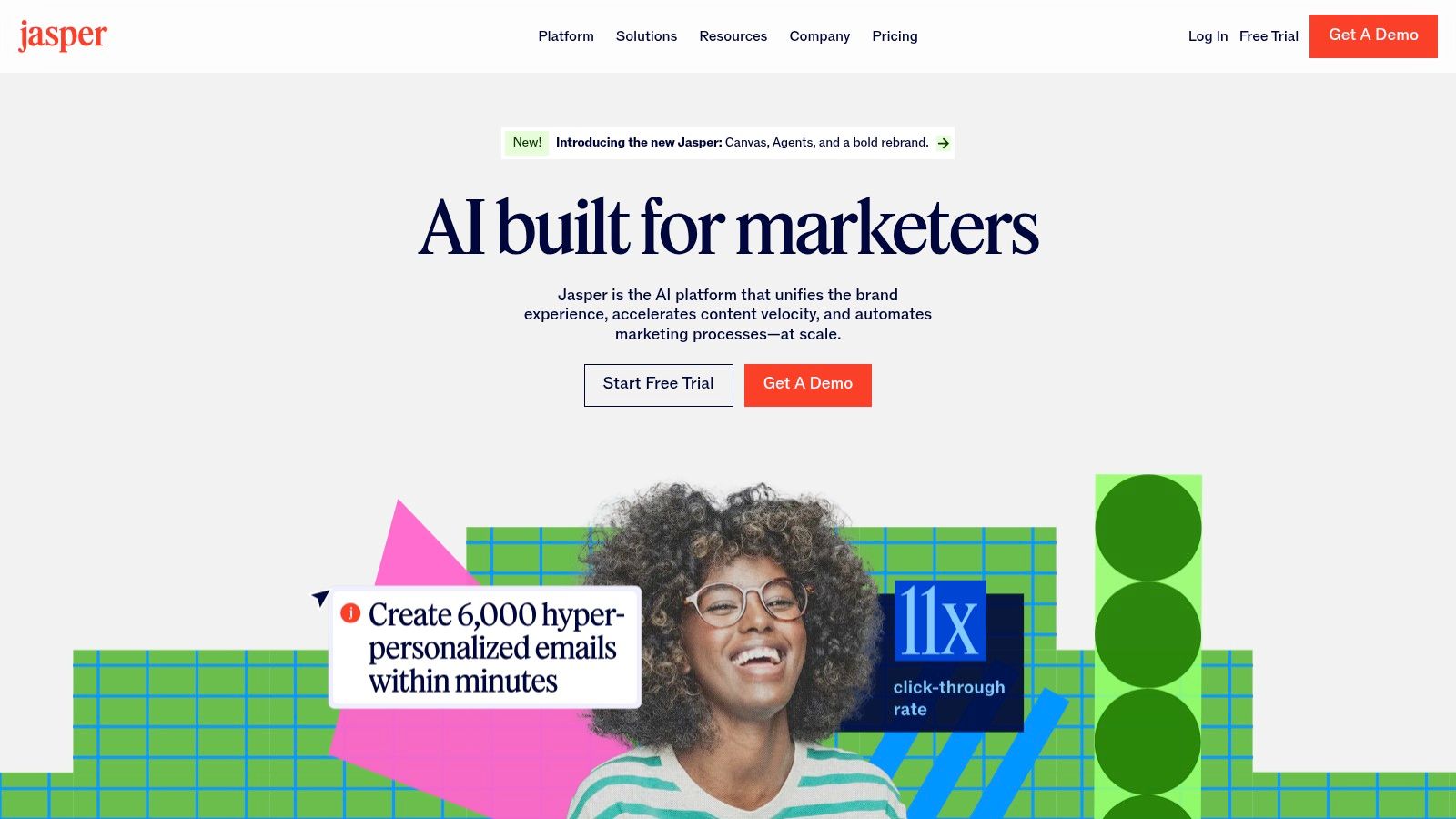
Jasper.ai has established itself as a premier AI writing assistant, focusing squarely on helping marketers generate high-quality content at scale. It excels at understanding context and brand voice, making it one of the most effective AI tools for marketing content creation. From drafting compelling ad copy and social media updates to generating long-form blog articles and email newsletters, Jasper acts as a powerful collaborator, significantly accelerating the content production pipeline for marketing teams of all sizes.
Key Features & Use Cases
Jasper’s core strength lies in its extensive library of over 50 templates, each tailored for a specific marketing task like “AIDA Framework,” “Video Script Hook and Introduction,” or “Blog Post Conclusion Paragraph.” What I find particularly useful is its “Brand Voice” feature, where I can provide URLs or text samples, and Jasper learns to mimic the tone, style, and terminology. This ensures consistency across all marketing channels. For example, a marketer can draft an entire campaign – from initial ad copy to a landing page and follow-up emails – all while maintaining a cohesive brand identity. An external report from the Content Marketing Institute notes that brand consistency can increase revenue by up to 23%.
Pricing and Accessibility
Jasper offers several plans designed for different levels of usage, with pricing based on word credits and features.
- Creator: From $39/month (billed annually)
- Pro: From $59/month (billed annually)
- Business: Custom pricing for teams and enterprises
The platform is known for its clean and intuitive user interface, which makes it easy for new users to get started. While the AI-generated content is impressively coherent, it’s crucial to fact-check and edit, especially for highly technical or niche subjects. Effective use involves treating Jasper as a creative partner rather than a fully autonomous writer; providing detailed prompts and guidance yields the best results.
- Pros: Dramatically speeds up content creation, excellent at maintaining brand voice, very user-friendly interface.
- Cons: Generated content requires human editing and fact-checking, can struggle with very complex or technical topics.
- Website: jasper.ai
5. Surfer SEO
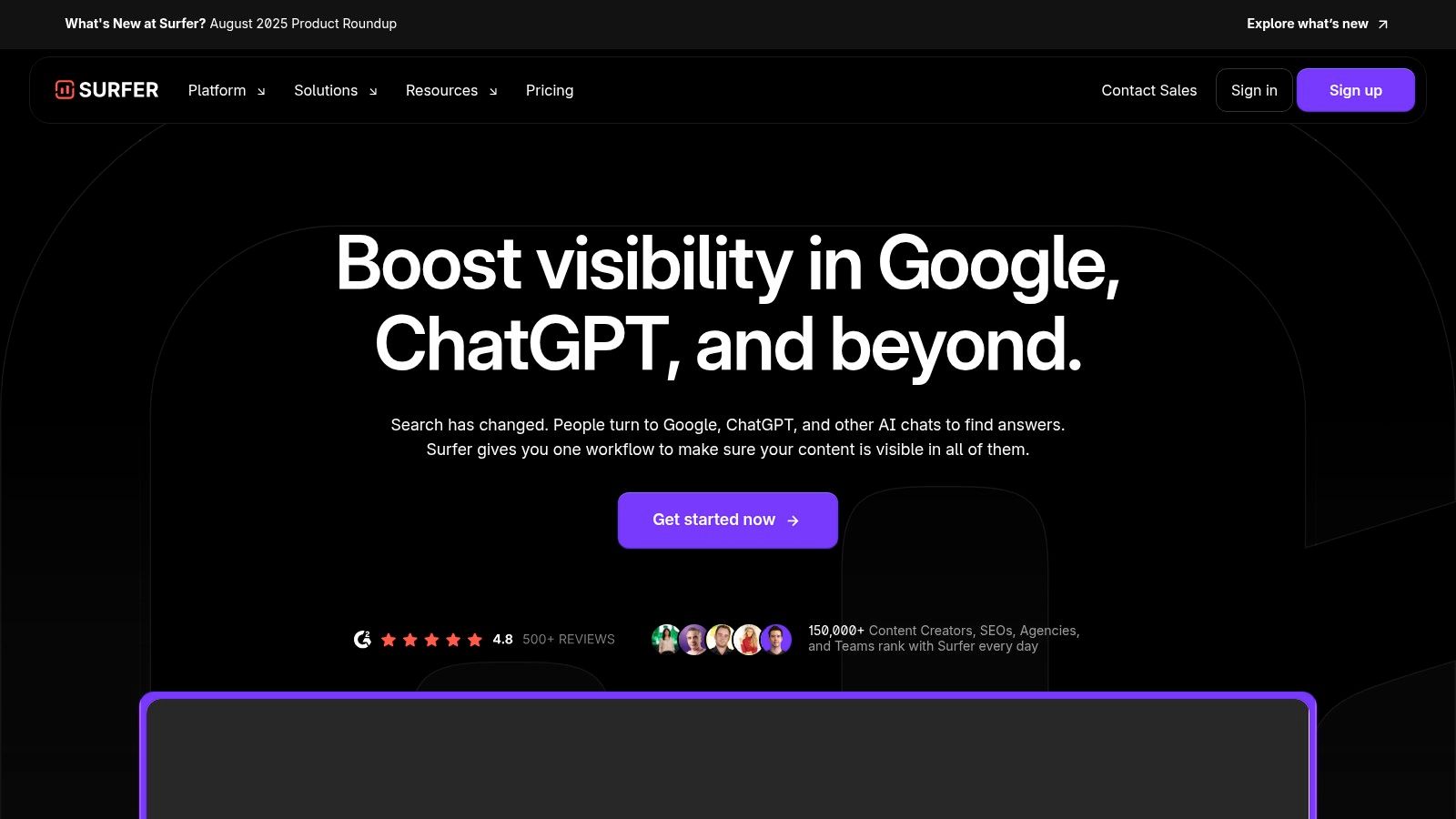
Surfer SEO has carved out a vital niche in the marketing landscape by focusing its AI power squarely on content optimisation for search engines. It acts as a data-driven guide, analysing top-ranking pages for a target keyword and providing a clear, actionable brief for creating content that can compete. Rather than just guessing what Google wants, Surfer gives you a blueprint based on what is already succeeding, making it one of the most practical AI tools for marketing for anyone serious about organic traffic. Its core function is to bridge the gap between content creation and technical SEO, ensuring every article is primed for visibility from the moment it’s published.
Key Features & Use Cases
The standout feature is Surfer’s Content Editor, which provides a real-time score as you write, based on factors like keyword density, word count, heading structure, and image usage. I find this incredibly useful as it turns SEO from a post-writing checklist into an integrated part of the creation process. For example, a content team can use the editor within Google Docs to ensure writers are hitting all the required SEO marks without needing deep SEO knowledge themselves. The tool’s competitor analysis also allows you to deconstruct why certain pages rank highly, revealing their structure and keyword strategy, a critical insight for outranking them. For those looking to explore similar platforms, it’s worth seeing how it compares against other leading AI SEO tools.
Pricing and Accessibility
Surfer SEO’s pricing is subscription-based, with different tiers based on usage volume.
- Essential: From $69/month (billed annually)
- Advanced: From $149/month (billed annually)
- Max: From $249/month (billed annually)
While there isn’t a free-forever plan, the investment is justified by the time saved and the improved ranking potential. The interface is clean and user-friendly, although beginners may need some time to understand the nuances of the data provided. The Google Docs and WordPress integrations are seamless, making it easy to incorporate into existing workflows.
- Pros: Streamlines on-page SEO, provides clear, data-driven content recommendations, excellent integrations.
- Cons: Subscription can be costly for individuals or small businesses, the data can be overwhelming for SEO novices.
- Website: surferseo.com
6. ManyChat
ManyChat has carved out a vital niche in the marketing landscape by focusing on AI-powered chat automation for social media. It excels at transforming passive social engagement into active, automated conversations on platforms like Facebook Messenger, Instagram, and WhatsApp. For businesses looking to scale customer interaction without a massive support team, ManyChat serves as an essential bridge, automating everything from lead qualification and appointment booking to answering frequently asked questions. This specialisation makes it one of the most effective AI tools for marketing when the goal is direct, conversational engagement.

Key Features & Use Cases
The platform’s core strength is its visual, flow-based builder, which allows marketers to design complex conversational sequences without writing any code. For instance, I can set up a flow that triggers when someone comments on an Instagram post, sending them a DM to offer a discount code. This message can then guide them through product options and direct them to the website, capturing lead information along the way. The AI component analyses user input to provide relevant answers, creating a more natural and helpful user experience that drives higher conversion rates. Research from Gartner predicts that by next year, a quarter of all customer service operations will integrate chatbot technology.
Pricing and Accessibility
ManyChat offers a very accessible entry point with a free plan that supports up to 1,000 contacts. Paid plans expand on this:
- Pro: From $15/month (price scales with contacts)
- Premium: Custom pricing for larger businesses
The platform is renowned for its user-friendly interface, making it possible to launch a functional chatbot within hours. While the basics are simple, mastering advanced segmentation and integrating it with other tools like a CRM or email service provider requires some learning. The value is clear for e-commerce brands and local businesses that rely heavily on social media for customer acquisition and support.
- Pros: Excellent for social media engagement, very easy to set up basic bots, strong free plan.
- Cons: Limited to specific messaging platforms, can become costly as your contact list grows.
- Website: https://manychat.com/
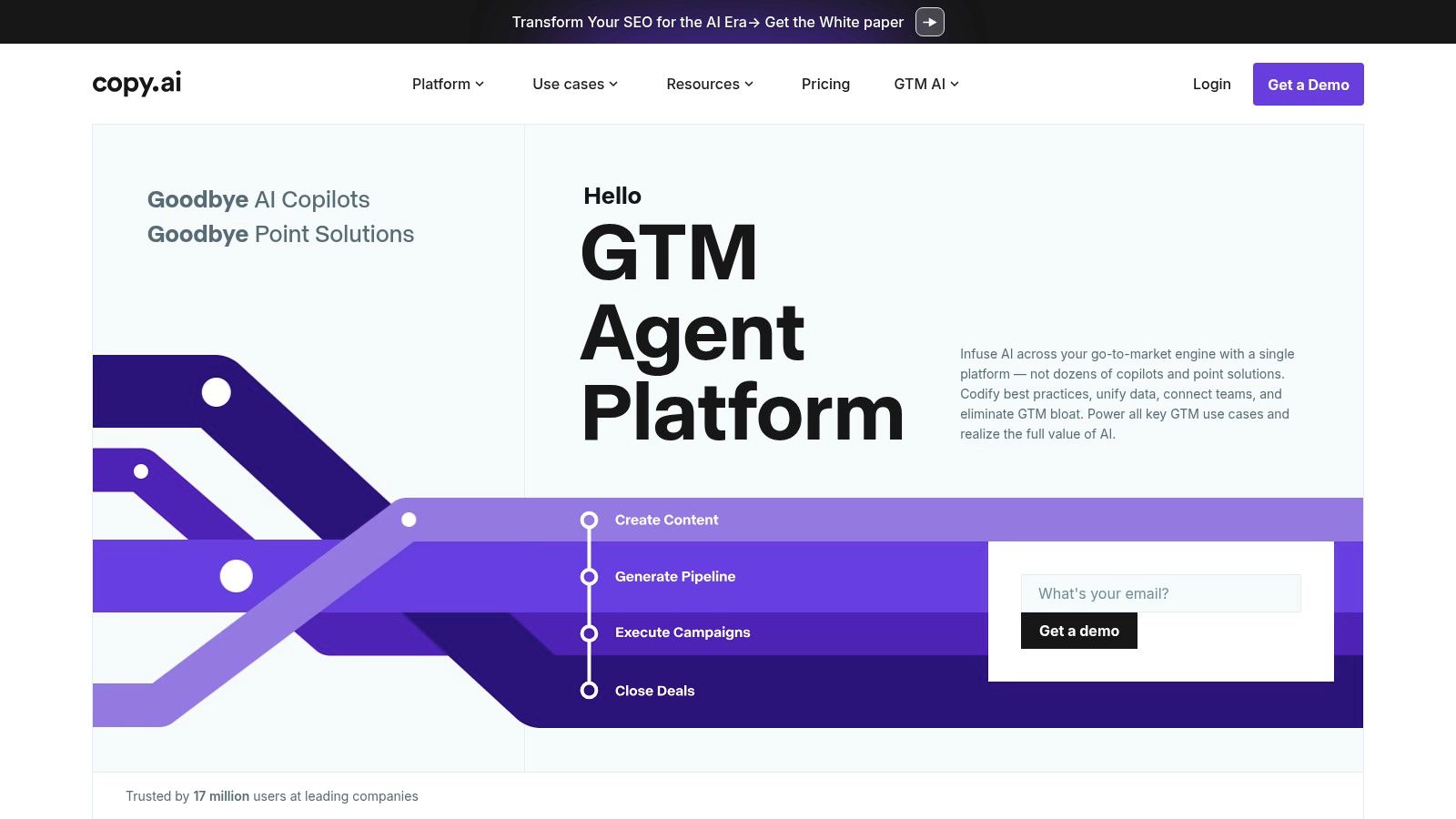
7. Copy.ai
Copy.ai positions itself as a creative partner for marketers, designed to break through writer’s block and rapidly generate diverse marketing copy. It excels as one of the most accessible AI tools for marketing, focusing squarely on content creation without the complexity of a full marketing suite. Its core strength is its vast library of templates, which guide the AI to produce everything from catchy social media updates and compelling ad copy to detailed blog post outlines and persuasive email newsletters. This makes it an invaluable asset for teams needing to produce high volumes of content quickly.
Key Features & Use Cases
What makes Copy.ai stand out is its user-friendly, template-driven approach. With over 90 specialised tools, a user can simply select a task like “Product Descriptions” or “Blog Intro,” provide a few basic details, and receive multiple creative options in seconds. For instance, I find it particularly effective for brainstorming. I can input a single product feature and generate ten different benefit-driven headlines, providing a fantastic starting point for a campaign. The platform also includes a long-form document editor, allowing you to build out initial ideas into complete articles, all within the same interface.
Pricing and Accessibility
Copy.ai offers a simple and scalable pricing model, including a generous free forever plan:
- Free: 2,000 words per month and access to all 90+ copywriting tools.
- Pro: From $36/month (billed annually) for unlimited words and priority support.
- Enterprise: Custom pricing for larger teams needing collaboration features.
The free plan is perfect for individuals or small businesses wanting to test the waters. The interface is exceptionally clean and intuitive, requiring almost no learning curve. While the AI-generated content often needs a human touch for fact-checking and brand voice alignment, its ability to accelerate the initial drafting process is undeniable.
- Pros: Very user-friendly, generous free plan, wide variety of specific copywriting templates.
- Cons: Generated content requires manual editing and fact-checking, can occasionally be slow.
- Website: https://www.copy.ai/
8. Zapier
Zapier functions as the central nervous system for a modern marketing stack, connecting disparate applications to automate workflows without a single line of code. While not a conventional AI tool in itself, its power lies in enabling AI-driven processes across more than 7,000 integrated apps. For marketers, this means you can create automated sequences, or “Zaps,” that trigger actions based on AI-generated events. This makes it an indispensable one of the most flexible AI tools for marketing, acting as the glue that binds your specialised AI platforms together into a cohesive, automated machine.
Key Features & Use Cases
Zapier’s strength is its unparalleled connectivity. A practical use case could involve automatically creating a task in your project management tool (like Asana) whenever a new lead is identified by your AI-powered CRM. Another example I’ve used is connecting an AI content generator, like Jasper, to WordPress. Once an article is drafted by the AI, a Zap can automatically create a new draft post in WordPress, assign it to an editor, and notify them via Slack. This transforms isolated AI outputs into seamless, end-to-end marketing operations, saving countless hours of manual data transfer and coordination.
Pricing and Accessibility
Zapier provides a freemium model that is highly accessible for getting started.
- Free: Forever free plan with limited tasks.
- Starter: From £16.30/month
- Professional: From £40.00/month
- Team: From £56.28/month
The user interface is famously intuitive, making basic automation creation straightforward even for non-technical users. However, designing complex, multi-step Zaps with conditional logic requires a more strategic approach and can have a steeper learning curve. The main dependency is the reliability of the APIs of the apps you connect, as Zapier’s performance is tied to them.
- Pros: Massive library of app integrations, user-friendly interface for simple workflows, saves significant manual effort.
- Cons: Complex automations can be tricky to set up, reliant on the performance of third-party apps.
- Website: https://zapier.com/
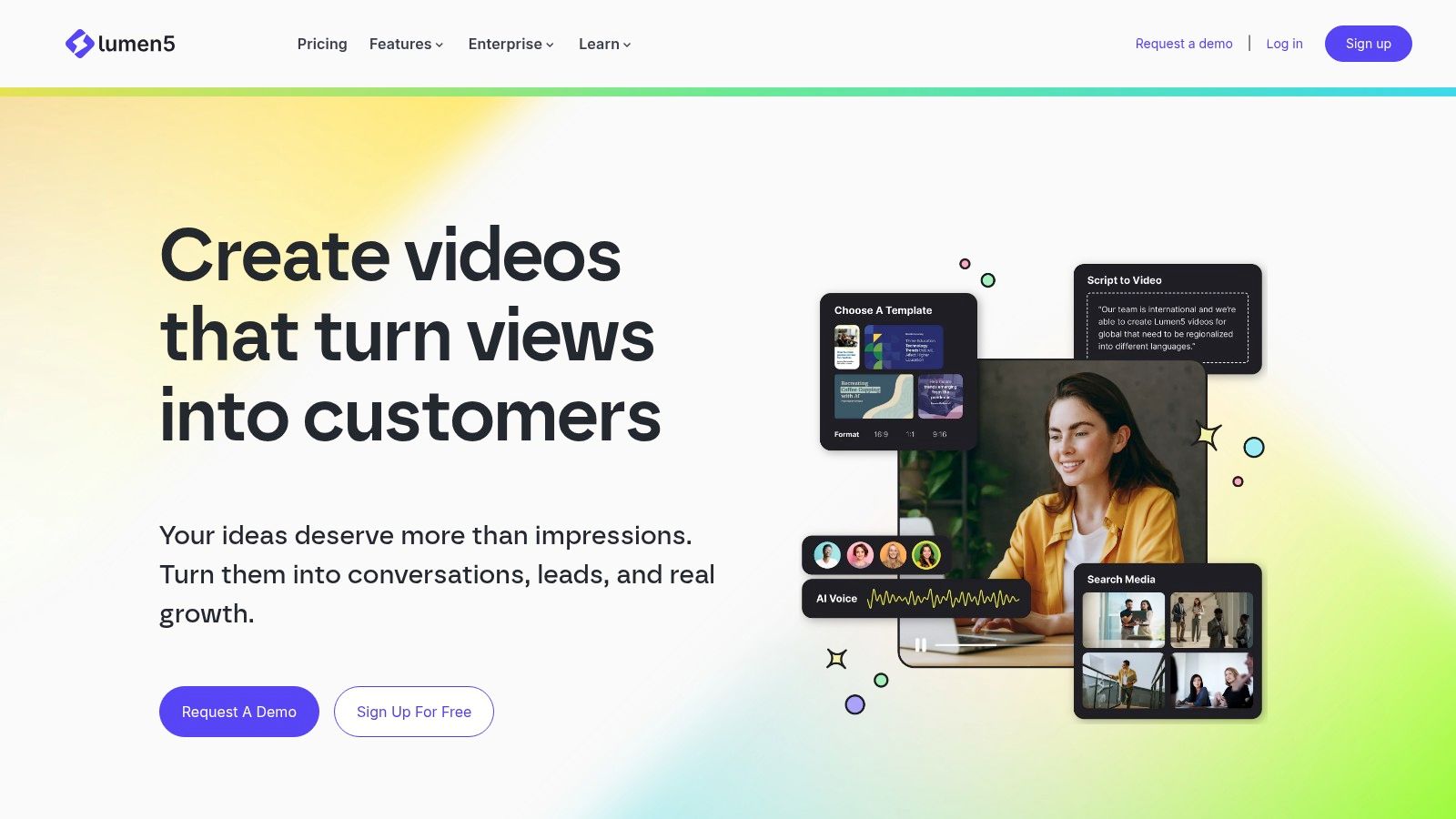
9. Lumen5
Lumen5 is a standout AI-powered video creation platform designed to transform text-based content into engaging social videos. For marketers looking to maximise their content’s reach, it offers a simple solution for repurposing blog posts, white papers, and articles into a more dynamic format. The platform uses AI to analyse your text, suggest relevant visuals from a vast stock library, and even synchronise scenes to a suitable music track, making it one of the most efficient AI tools for marketing when it comes to video production.
Key Features & Use Cases
The core strength of Lumen5 lies in its “text-to-video” engine. Simply by pasting a link to a blog post, its AI summarises the content into key scenes, pulling out important sentences for on-screen text. It then automatically selects corresponding stock videos and images to create a cohesive narrative. From there, I find the drag-and-drop editor intuitive, allowing me to easily swap visuals, adjust branding with custom colours and logos, and change the pacing. This is perfect for creating quick, shareable videos for social media feeds or as supplementary content within articles to boost engagement. According to Wyzowl’s 2023 State of Video Marketing report, 91% of businesses now use video as a marketing tool.
Pricing and Accessibility
Lumen5 offers a clear pricing model, including a free-forever Community plan.
- Community: Free (includes watermark)
- Basic: From $19/month (billed annually)
- Starter: From $59/month (billed annually)
- Professional: From $149/month (billed annually)
The free plan is an excellent entry point for trying the platform, though the watermark is a significant limitation for professional use. The paid tiers unlock more features, higher-quality video exports, and a larger media library. While the AI does an impressive job, its initial video drafts often require manual tweaks to ensure the visuals perfectly match the text’s nuance, so some hands-on editing is usually necessary.
- Pros: Radically simplifies video creation, no technical editing skills needed, great for content repurposing, free version available.
- Cons: AI-selected media can sometimes miss the mark, free videos are watermarked, less control than traditional video editors.
- Website: https://lumen5.com/
10. Pictory
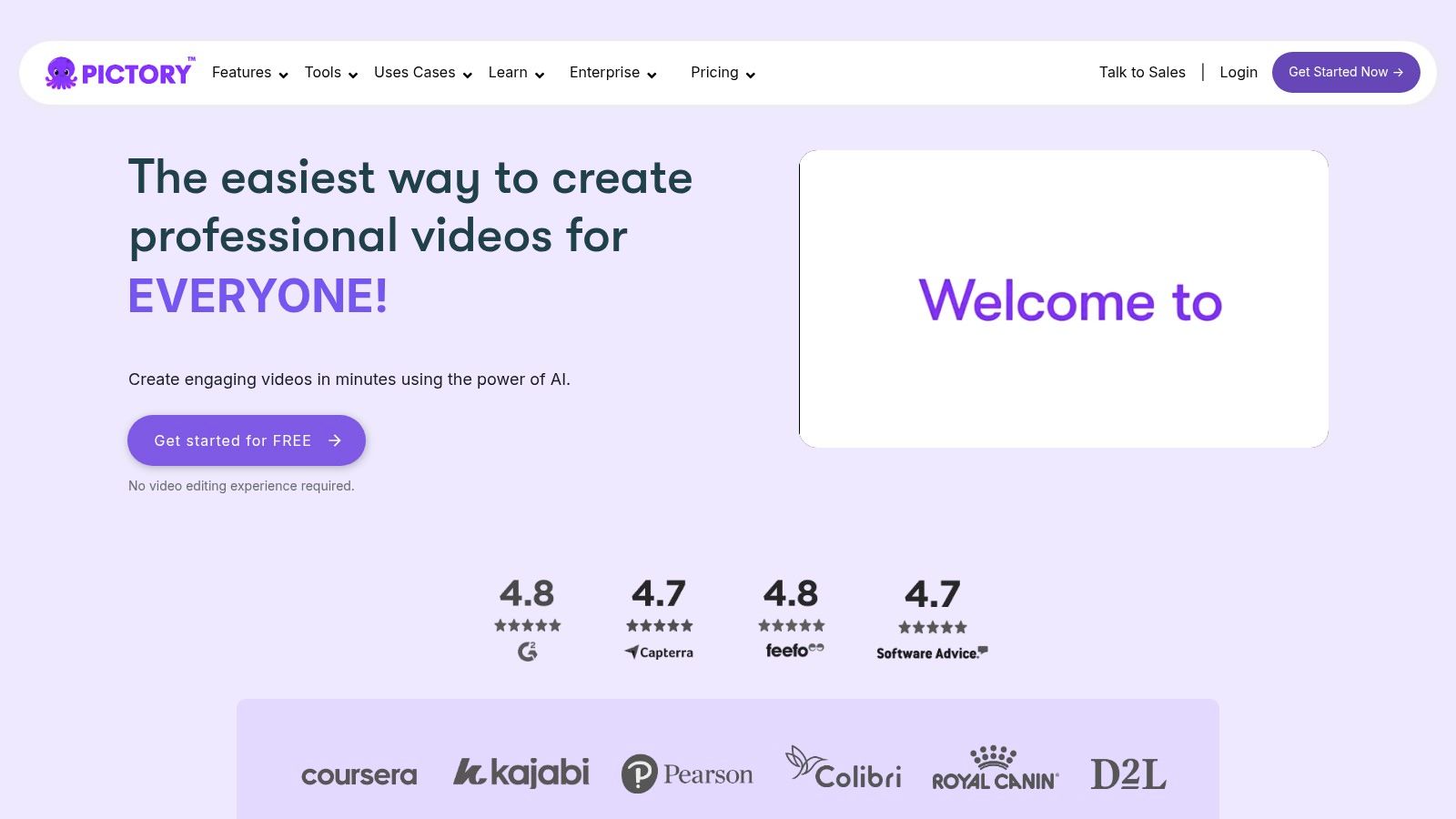
Pictory carves out a vital niche in the world of content marketing by using AI to transform text into engaging, short-form videos. In an era where video content dominates social media feeds, Pictory allows marketers to repurpose existing assets like blog posts, scripts, or articles into visually appealing videos in minutes. This makes it one of the most practical AI tools for marketing, especially for teams looking to boost their social media presence and engagement without extensive video production resources or skills.
Key Features & Use Cases
Pictory’s core strength is its “Script to Video” feature, which analyses your text, selects relevant stock footage from its extensive library, and adds AI-generated voiceovers and music. This is incredibly useful for creating quick promotional clips, educational content, or social media stories from existing long-form content. For example, I can take key points from a detailed case study and turn them into a 60-second video for LinkedIn or Instagram, drastically expanding the content’s reach. For those wanting to delve deeper into AI-powered video creation, you can find a comprehensive guide to various video tools on mersudinforbes.com.
Pricing and Accessibility
Pictory’s pricing is accessible for businesses of all sizes, making professional video creation affordable.
- Standard: From $23/month
- Professional: From $47/month
- Teams: From $119/month
The platform’s interface is remarkably user-friendly, guiding you through the creation process step-by-step. While customisation can feel a bit limited compared to traditional video editing software, its purpose is speed and efficiency, which it delivers exceptionally well. The free trial is a great way to test its capabilities before committing to a plan.
- Pros: Extremely fast video creation from text, huge library of stock assets, no video editing experience required.
- Cons: Limited advanced customisation options, AI voiceovers can sometimes sound robotic.
- Website: pictory.ai
11. Canva
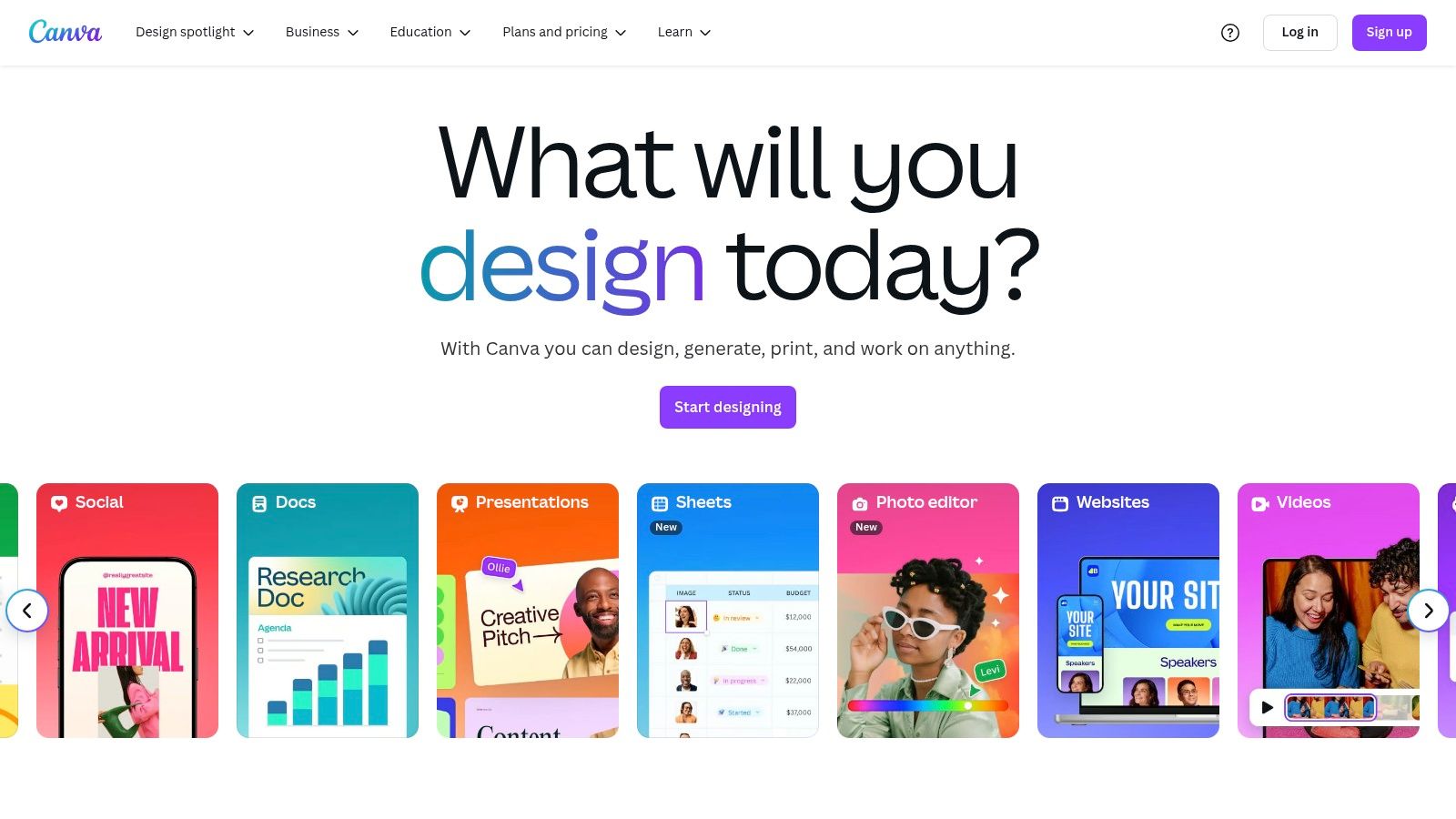
Canva has transformed from a simple graphic design tool into a powerful, AI-enhanced creative suite, making it an indispensable resource for marketers of all skill levels. Its core strength is democratising design, allowing anyone to produce professional-grade visuals for campaigns. The platform’s AI, branded as Magic Studio, is woven into its very fabric, offering smart suggestions for layouts, generating text, and even creating entire presentations from a simple prompt. This makes Canva one of the most accessible AI tools for marketing for producing high-volume, quality creative assets without a design background.
Key Features & Use Cases
The AI features within Canva dramatically speed up the content creation workflow. For instance, a social media manager can use Magic Write to brainstorm campaign slogans, then use Magic Design to instantly generate a dozen on-brand post variations. From there, Magic Animate can bring static designs to life for video ads or engaging stories. I find its real power lies in consistency; you can set up a Brand Kit with your logos, fonts, and colour palettes, and the AI will apply these elements across all generated designs, ensuring brand integrity with minimal effort.
Pricing and Accessibility
Canva’s pricing model is designed to be highly inclusive, catering to individuals and large teams alike.
- Free: A robust free-forever plan with generous access to templates and AI tools.
- Pro: From £10.99/month for one person.
- Teams: From £22/month for the first five people.
The user experience is Canva’s greatest asset; its drag-and-drop interface is famously intuitive. While the free version is more than sufficient for many basic tasks, subscribing to the Pro plan unlocks premium stock content and the full suite of Magic Studio AI tools. Its simplicity means there is almost no learning curve, allowing marketing teams to become productive immediately.
- Pros: Extremely user-friendly, vast library of templates and assets, generous free version.
- Cons: Advanced AI features are behind a paywall, limited native app integrations compared to enterprise platforms.
- Website: https://www.canva.com/
12. Brand24
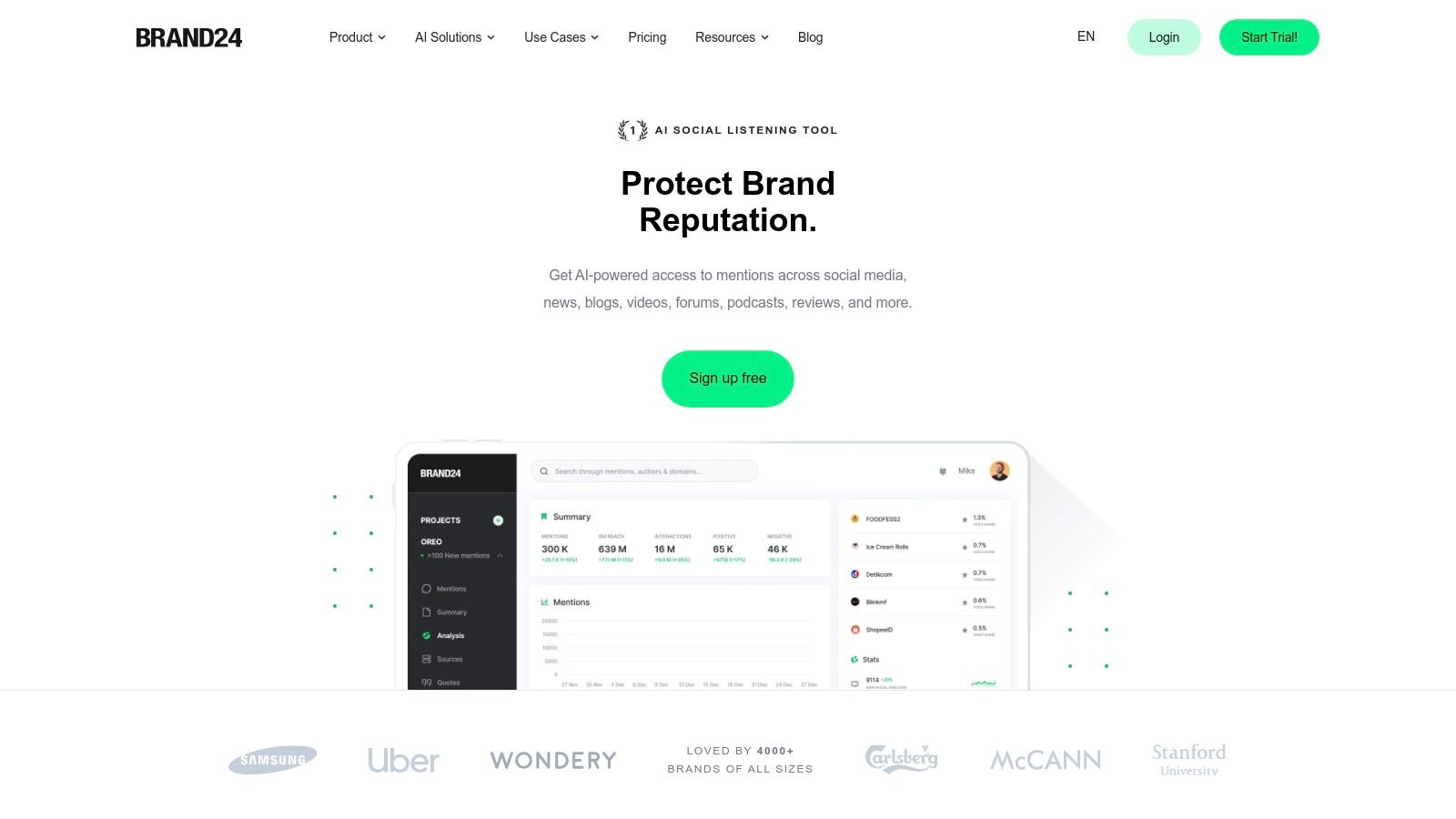
Brand24 excels in the digital listening space, leveraging AI to transform how businesses monitor their online presence. It moves beyond simple keyword tracking by providing real-time alerts and in-depth analysis of brand mentions across social media, news sites, blogs, and forums. This makes it an indispensable one of the AI tools for marketing focused on reputation management and understanding public perception. The platform’s core strength is its ability to instantly gauge brand health, identify emerging trends, and react to customer conversations as they happen.
Key Features & Use Cases
The real power of Brand24 lies in its AI-driven sentiment analysis, which automatically categorises mentions as positive, negative, or neutral. This allows marketing teams to quickly address customer complaints or amplify positive feedback. For example, a marketing manager can set up alerts for negative comments about a new product launch, allowing them to engage directly and mitigate potential PR crises. Furthermore, the tool is excellent for identifying key influencers and brand advocates within your niche, providing a data-backed approach to building valuable partnerships. As an example from my own experience, I undertook a project for a client and used Brand24 to identify a niche but highly vocal community on Reddit discussing a competitor’s product flaws. We then tailored our messaging to address those specific pain points, leading to a noticeable uplift in leads from that community.
Pricing and Accessibility
Brand24 offers several tiers, making it accessible for different business sizes.
- Individual: From $79/month
- Team: From $149/month
- Pro: From $199/month
- Enterprise: From $399/month
The platform is known for its user-friendly dashboard and intuitive setup, though fine-tuning keyword filters to eliminate noise can take some initial effort. The automated reporting features are a significant time-saver, delivering professional-looking PDF reports with actionable insights that are easy to share with stakeholders.
- Pros: Powerful real-time social listening, excellent sentiment analysis, user-friendly dashboard.
- Cons: Pricing can be a barrier for very small businesses, initial keyword setup requires careful tuning.
- Website: brand24.com
Top 12 AI Marketing Tools Feature Comparison
| Tool | Core Features | User Experience | Unique Selling Points | Target Audience | Price Point/Notes |
|---|---|---|---|---|---|
| Clay | AI-driven prospecting, lead insights | User-friendly, some learning curve | Automates lead discovery, multi-source data | Sales & marketing professionals | Not specified |
| HubSpot Marketing Hub | CRM, marketing automation, analytics | Intuitive, scalable | All-in-one marketing platform | Businesses of all sizes | Higher cost |
| Mailchimp | Email marketing, AI insights, automation | Intuitive, strong automation | Comprehensive free plan | Small to medium businesses | Free and paid plans |
| Jasper.ai | AI content creation, multi-format | User-friendly | Maintains brand voice | Marketers, content creators | Paid plans |
| Surfer SEO | On-page SEO optimization, competitor analysis | Easy to use, learning curve | Real-time SEO content scoring | SEO professionals, marketers | Subscription required |
| ManyChat | Chatbots, social media integration | Easy setup, limited platforms | Automates customer messaging | Social media marketers | Free & paid plans |
| Copy.ai | AI copy generation, plagiarism checker | User-friendly | Wide variety of templates | Writers, marketers | Free and paid plans |
| Zapier | App integration, no-code automation | User-friendly | Connects 7000+ apps | Marketers, businesses | Subscription-based |
| Lumen5 | Video creation from text, templates | Simple, drag & drop | Auto visuals & music selection | Marketers, content creators | Free version with watermark |
| Pictory | Video creation, stock library | Easy editing | Social media video focus | Social media marketers | Free version limits features |
| Canva | Graphic design, AI suggestions | Accessible, drag & drop | Huge template library | Non-designers, marketers | Free & paid plans |
| Brand24 | Social listening, sentiment analysis | User-friendly dashboard | Real-time brand monitoring | Brand managers, marketers | Higher price tier |
Choosing the Right AI Tools for Your Marketing Goals
The landscape of digital marketing is undeniably being reshaped by artificial intelligence. Throughout this guide, I have walked you through some of the most powerful and innovative AI tools for marketing available today, from prospecting powerhouses like Clay to content creation assistants like Jasper and SEO optimisers like Surfer SEO. Each platform offers a unique set of capabilities designed to solve specific marketing challenges, but the true value isn’t found in simply owning a subscription. The real power is unlocked when you strategically select and integrate these tools into a cohesive, goal-oriented marketing engine.
The sheer volume of options can feel overwhelming. It’s easy to get distracted by flashy features and promises of instant success. However, as an SEO specialist who has navigated complex digital ecosystems for both large enterprises and growing e-commerce stores, I can assure you that technology is only as effective as the strategy guiding it. These tools are meant to augment your expertise and creativity, not replace them. They are co-pilots, designed to handle the repetitive, data-heavy tasks, freeing you up to focus on the high-level strategy, customer relationships, and creative thinking that truly drives growth.
A Practical Framework for Selecting Your AI Stack
Before you commit to a new tool, it’s crucial to take a step back and audit your current processes. Don’t adopt technology for technology’s sake. Instead, follow a deliberate approach to ensure you’re solving a real problem and generating a tangible return on investment.
Start by asking these fundamental questions:
- What is my single biggest marketing bottleneck? Is it the time it takes to write blog posts? The difficulty in personalising email campaigns at scale? Or perhaps the challenge of monitoring brand mentions across the web? Identify the most significant friction point in your workflow. If content creation is your main struggle, a tool like Copy.ai or Jasper would be a logical starting point. If lead qualification and outreach are slowing you down, Clay is built for that exact purpose.
- Which tool aligns with my primary business objective? If your goal is to boost organic traffic and search rankings, Surfer SEO is a non-negotiable. If you need to improve customer engagement and support on social media, ManyChat’s chatbot capabilities are paramount. For e-commerce brands on Shopify, tools that automate visual content like Lumen5 or Pictory can be invaluable for creating product videos and ads.
- Does this tool integrate with my existing systems? A powerful AI tool that operates in a silo is an inefficient one. The magic often happens in the connections. Consider platforms like HubSpot Marketing Hub, which acts as a central nervous system, or Zapier, the digital duct tape that connects disparate applications. Ensure your new tool can communicate with your CRM, email service provider, and other core marketing platforms to create a seamless flow of data.
- What is my budget and what is the potential ROI? Be realistic about your financial resources. Many of the tools I’ve covered, such as Mailchimp and Canva, offer robust free or entry-level plans. Start there. Test the platform, prove its value with a small project, and then use that data to justify an upgrade. Calculate the time you’ll save and the potential revenue you’ll generate to make a strong business case.
Moving from Selection to Successful Implementation
Once you have chosen a tool, resist the temptation to implement everything at once. This is a common pitfall that leads to frustration and abandonment. Instead, adopt a phased approach. Select one or two tools that address your most pressing needs and commit to mastering them.
Focus on a single use case first. For instance, if you’ve chosen Jasper, dedicate the first month solely to using it to draft your weekly blog posts. Track the time saved and the quality of the output. If you’ve opted for Brand24, focus initially on setting up alerts for your brand name and one key competitor. By starting small, you build confidence, demonstrate value, and create a scalable process that your team can easily adopt.
The journey into leveraging AI tools for marketing is a marathon, not a sprint. The platforms I have detailed are at the forefront of this technological revolution, but the field is constantly evolving. By adopting a mindset of continuous learning and strategic implementation, you can transform these tools from mere software into indispensable partners in achieving your marketing goals. You will gain deeper customer insights, automate mundane tasks, and ultimately free yourself to perform the strategic work that drives meaningful, measurable results for your business.
Feeling overwhelmed by the technical side of SEO and how to integrate these AI tools effectively? At Mersudin Forbes Digital, I specialise in demystifying SEO and building data-driven strategies that deliver real-world results for e-commerce and B2B businesses. Let me help you build a powerful, AI-enhanced marketing strategy by visiting Mersudin Forbes Digital today.