Effective SEO Strategy for an Ecommerce Website That Delivers Results

Getting your SEO strategy for an ecommerce website right isn’t just another task on the to-do list; it’s the most reliable, cost-effective way to get a steady stream of high-intent traffic heading straight for your products. A solid plan means you’re not constantly throwing money at paid ads. Instead, you’re building a real asset that actually grows in value over time.
Building Your E-commerce SEO Foundation
Before I even think about advanced tactics like keyword mapping or link building, I always make sure the fundamentals are rock-solid. I’ve seen so many online stores fail with SEO because they jump straight to the exciting bits without getting the foundation right first. A strong plan starts with a clear understanding of your market, your customers, and the unique hurdles that come with e-commerce.
SEO for an online shop is a completely different beast compared to SEO for a blog or a service business. The focus shifts dramatically. You’re hunting for commercial-intent keywords, obsessing over the user experience on product pages, and wrestling with the technical side of managing a large inventory. Think about it: research from sources like Statista consistently shows a high percentage of shoppers research products online before they buy. That means their searches are often super specific and signal a clear intent to pull out their wallets.
Defining Your Starting Point
My process always kicks off with an audit of three core pillars. Nailing these from the get-go saves a ton of wasted time and money down the line. Skipping this initial assessment is like building a house on dodgy ground—it’s just asking for trouble.
- Technical Site Health: Is your site fast? Mobile-friendly? Can Google even crawl it properly? Simple things like slow page speed, broken links, or duplicate content can kill your efforts before you even start.
- On-Page Relevance: Do your category and product pages actually talk about what you sell, using the words your customers are searching for? This is all about optimising titles, descriptions, and content to match what people are looking for.
- Off-Page Authority: Does your brand have a credible presence online? This pillar is about building trust and authority through high-quality backlinks and brand mentions from places that matter.
The biggest mistake I see is people focusing on just one of these, usually stuffing keywords on a page. Real success comes from a balanced approach where a technically sound site supports relevant content, which in turn gets a boost from external authority.
Aligning SEO with Business Goals
A good SEO strategy isn’t something that happens in a silo. It needs to be directly tied to what you’re trying to achieve as a business. Are you trying to shift more of a specific product line? Break into a new market? Or maybe you just want to become the go-to name in your niche?
Let’s say a client of mine sells handmade leather bags in the UK. A key business goal might be to increase sales of their premium tote bag range by 20% in the next six months. My SEO approach would immediately zero in on that:
- I’d start by finding high-intent keywords like “handmade leather tote bag UK” or “luxury British tote bags”.
- Next, I’d make sure the tote bag category page and all the individual product pages are perfectly optimised for those terms.
- Then, I might create some content, like a “Guide to Choosing the Perfect Leather Tote,” to catch potential buyers earlier in their research.
- Finally, I’d focus on building links from UK-based fashion and lifestyle blogs to build up the authority of those specific pages. For example, I might reach out to a publication like Country & Town House with their “Best of British” section.
This targeted approach ensures every single SEO task is directly contributing to a measurable business outcome. You can learn more by exploring our detailed guide on SEO for ecommerce websites, which dives deeper into these foundational ideas. By starting with this clear, strategic framework, you’re setting yourself up for sustainable growth and a serious competitive edge.
Uncovering Keywords That Drive Sales

If you get one thing right in your SEO strategy for an ecommerce website, make it keyword research. It’s the absolute foundation. This isn’t just about pulling a list of high-volume terms; it’s about getting inside your customer’s head and figuring out the exact words they type into Google when they’re itching to buy something.
My first job is always to build a detailed map that connects what a customer wants directly to the right page on your site.
Think about it like a physical shop. Your category pages are the big, signposted aisles, and your product pages are the individual items sitting on the shelves. Get the labelling wrong, and you’ll just confuse people, leading to abandoned carts and zero sales.
Differentiating Keyword Intent
The first thing I always do is split keywords up by user intent. It’s a crucial step that tells me which type of page to map them to. There’s no point trying to make a product page rank for a really broad search term – it’s a losing battle and frankly, a bad experience for the user.
Here’s how I break it down:
- Informational Keywords: People are in research mode here (e.g., “what is the best camera for vlogging”). These are perfect for blog posts and in-depth buying guides.
- Navigational Keywords: The user knows who they’re looking for (e.g., “Mersudin Forbes Digital blog”). Your homepage and main brand pages will naturally catch these.
- Commercial Investigation Keywords: These shoppers are getting serious. They’re weighing up their options (e.g., “sony a7iii vs canon r6”). Category pages or detailed comparison articles work wonders here.
- Transactional Keywords: This is where the money is. The searcher is ready to buy, credit card in hand (e.g., “buy sony a7iii camera online UK”). These must be the main focus for your product pages.
Following this method means that when someone lands on your site, the page they see is exactly what they were hoping to find.
Building Your Keyword Universe
With the different intent types sorted, I start pulling together a massive list of potential keywords. I never stick to just one tool. I’ll combine data from multiple sources to make sure I don’t miss a single opportunity.
I usually start broad and then drill down. For instance, if I’m working with a fashion brand, I might kick off with a seed keyword like “women’s dresses.” From there, I’ll use a tool like Ahrefs to expand that single term into thousands of potential variations. For a practical example, I might discover long-tail keywords like “green floral midi dress for wedding guest” which signal very high purchase intent.
The real magic happens when you uncover long-tail keywords. These longer, more specific phrases (like “black long sleeve midi dress size 12”) have lower search volume but convert like crazy because the searcher knows exactly what they want.
After gathering this huge list, I move on to the mapping phase. This is where I assign a primary keyword and a handful of secondary ones to every important page on the site, from the homepage down to the most specific product page. This map becomes the blueprint for all your on-page optimisation. You can use a detailed ecommerce SEO checklist to keep this process organised.
Analysing the Competitive Landscape
You can’t build a winning strategy without looking at what the competition is up to. I use tools like Semrush to see the exact keywords that are sending the most traffic to my client’s main competitors.
This competitor analysis helps me find “keyword gaps” – those valuable terms your rivals are ranking for, but you aren’t. For example, if I’m working with a sports shoe retailer and see a competitor like Sports Direct ranking for “best trail running shoes for beginners” but my client isn’t, that’s a clear content opportunity. These gaps are often fantastic quick wins.
The payoff for getting this right is huge. A solid organic presence is a massive financial asset. On average, a successful e-commerce brand can drive thousands of monthly visits that would otherwise cost thousands of pounds in paid advertising. It really shows how critical it is to nail your keyword research from day one.
Optimising Your Site Structure and On-Page Elements

Once I’ve got a solid keyword map, the next job is turning that plan into a logical site structure. I always think of a website’s architecture like the blueprint for a house; if it’s a confusing maze, people will get lost and leave. The same goes for users and search engine crawlers.
My main goal is simple: create a clean, scalable structure that makes it dead easy for Google to find and index every single product. At the same time, it has to guide customers from a broad search right through to a specific purchase without any hassle.
Designing an Intuitive Site Architecture
I’m a big fan of a ‘flat’ site architecture. All this means is making sure no product page is more than three clicks away from the homepage. It’s a simple rule, but it works wonders for spreading the authority (or ‘link equity’) from your powerful homepage down to your product pages, giving them a much-needed SEO boost.
A typical journey should be this straightforward:
- Homepage -> Category Page (e.g., Men’s Running Shoes) -> Product Page (e.g., Nike Air Zoom Pegasus 40)
This clean hierarchy stops your most important pages from getting buried deep within the site where no one can find them.
To make this structure work, I focus on two key things:
- Clean URL Structures: Your URLs need to be short, descriptive, and easy for a human to read. I always steer clear of long strings of random numbers and parameters. A good URL should mirror the site hierarchy, like
yourstore.co.uk/mens-running-shoes/nike-air-zoom-pegasus. - Breadcrumb Navigation: Honestly, this is non-negotiable for e-commerce. Breadcrumbs show users their path (e.g., Home > Men’s Shoes > Running Shoes) and build a web of powerful internal links that help Google figure out how all your pages relate to each other.
A well-organised site structure isn’t just an SEO tick-box exercise. It directly improves user experience, reduces bounce rates, and increases the time visitors spend on your site—all signals that tell Google your website is a high-quality resource.
Mastering On-Page SEO for Products and Categories
With the architecture sorted, I zoom in on the on-page elements. This is where I take all those keywords from the research phase and weave them into the fabric of your category and product pages.
My process for optimising these pages is meticulous, and I’ve found that getting these small details right is often what separates the stores that rank from those that don’t.
Compelling Titles and Meta Descriptions
The page title is probably the single most important on-page SEO factor. I stick to a simple but effective formula that combines the primary keyword, your brand name, and a compelling benefit.
- For a Product Page: [Product Name] | [Key Feature/Benefit] | [Brand Name]
- Example: “Nike Air Zoom Pegasus 40 | Men’s Road Running Shoe | MyShoeStore”
Meta descriptions don’t directly affect rankings, but they have a massive impact on whether someone clicks on your result. I write them like a mini-advert, including the main keyword, highlighting a unique selling point (like “Free UK Delivery”), and finishing with a clear call to action.
Product Descriptions That Sell and Rank
Writing product descriptions is a balancing act. You need persuasive sales copy, but it also has to be optimised. I always write for the customer first, focusing on benefits, not just features. Then, I find natural ways to work in the primary and secondary keywords we found earlier.
To avoid ‘thin content’ issues, especially on sites with thousands of products, I make sure every description is unique and genuinely useful. For a clothing store, instead of just listing materials, I’d describe how the fabric feels, suggest styling ideas, and use phrases like “lightweight summer dress” or “formal evening wear”. A great example of this in practice is how a company like ASOS adds “Style Notes” to their descriptions.
Leveraging Visuals and Structured Data
Modern e-commerce SEO is about more than just words. High-quality images are crucial for conversions, and I make sure they’re optimised for search, too. That means using descriptive file names (like nike-pegasus-blue.jpg instead of IMG_1234.jpg) and writing detailed alt text that describes the image while including relevant keywords.
Finally, I always implement structured data, also known as schema markup. This is basically code that helps search engines understand your page content on a deeper level. For any e-commerce site, these are the must-haves:
- Product Schema: This allows Google to show rich snippets like price, availability, and review ratings right there in the search results.
- Review Schema: This makes those star ratings pop, helping your listing stand out from the crowd.
- Breadcrumb Schema: This explicitly tells Google where the page sits in your site’s hierarchy.
Getting all these on-page elements right turns each product and category page into its own highly optimised landing page, ready to attract and convert the right kind of organic traffic.
Tackling Common E-commerce Technical SEO Issues
Technical SEO can feel like the most daunting part of putting together an SEO strategy for an e-commerce website. But from my experience, it’s often where the biggest and fastest ranking improvements are hiding. When you get the technical foundations right, every other part of your strategy—from the content you write to the links you build—just works so much better.
My first port of call is always site speed. Yes, it’s a massive ranking factor, but honestly, it’s a non-negotiable for a good customer experience. A slow site is frustrating, and it sends potential customers straight to your competitors. I always treat it as priority number one.
This breakdown shows the performance of different content formats I often use in e-commerce strategies.
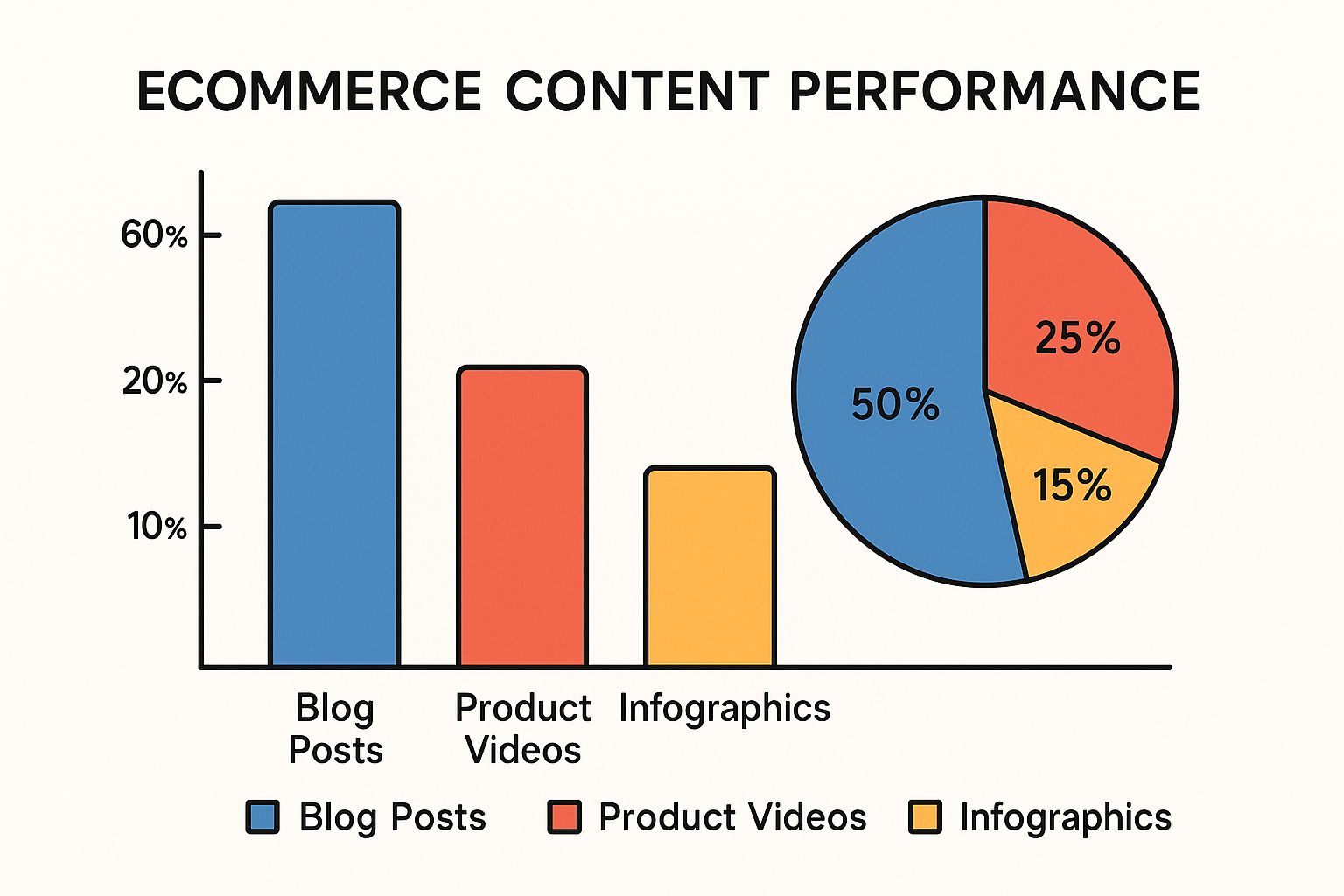
As you can see, well-optimised blog posts tend to form the backbone of a solid strategy, driving the most consistent traffic over the long haul.
My Core Web Vitals Audit Checklist
When I’m auditing a site for speed, I’m zeroed in on Google’s Core Web Vitals. These aren’t just vanity metrics; they measure the real-world experience a user has on your site. Improving them almost always has a direct, positive knock-on effect on your rankings.
Here’s my personal checklist:
- Image Compression: I run every single image through a tool like TinyPNG before it gets uploaded. It drastically cuts down the file size without any noticeable drop in quality.
- Lazy Loading: This is a simple but incredibly powerful trick. It just means images and videos only load when a user actually scrolls down to them. It makes a huge difference to how quickly the initial page loads.
- Server Response Time: I always check if the hosting is up to scratch. A slow server will sabotage even the most perfectly optimised website.
- Minifying Code: I get rid of all the unnecessary characters from CSS, JavaScript, and HTML files. It’s like tidying up the code, and it helps the site load that bit faster.
Getting your site speed right is absolutely crucial. Research, such as Google’s own impact studies, shows that conversion rates can drop significantly with every extra second a page takes to load. This presents a massive opportunity to get ahead of the competition. You can learn more about e-commerce best practices and see how simply improving these metrics gives you a direct competitive edge.
To help you get started, here’s a quick table of the most common technical gremlins I find on e-commerce sites and how I usually go about fixing them.
Common E-commerce Technical SEO Issues and Fixes
| Technical Issue | Why It Matters | How I Fix It |
|---|---|---|
| Slow Page Speed | Hurts user experience, conversions, and rankings. It’s a key Core Web Vitals metric. | I start with image compression, enable browser caching, minify CSS/JS, and check the server response time. |
| Duplicate Content | Dilutes your ranking signals across multiple URLs, confusing search engines. A classic e-commerce problem. | I use rel="canonical" tags to point to the ‘master’ page and block crawlers from faceted URLs via robots.txt. |
| Poor Mobile Experience | With most traffic coming from mobile, a clunky site is a conversion killer. Google uses mobile-first indexing. | I ensure the site has a responsive design, large tap targets, and fast mobile loading times. A full mobile audit is a must. |
| Thin Content on Product Pages | Pages with little unique text struggle to rank for anything beyond their specific product name. | I beef up product descriptions, add user-generated content like Q&As or reviews, and create detailed spec lists. |
| Broken Internal Links | Creates a frustrating dead-end for users and stops link equity from flowing through the site. | I run regular crawls with a tool like Screaming Frog to find and fix any 404 errors. |
This table isn’t exhaustive, of course, but tackling these five issues will solve a huge percentage of the technical problems that hold e-commerce sites back.
Managing Faceted Navigation and Duplicate Content
Faceted navigation—you know, those filters for size, colour, brand, and so on—is brilliant for users but can be a complete nightmare for SEO. If you don’t manage it properly, it can spit out thousands of unique URLs with nearly identical content. This creates massive duplicate content issues that water down your ranking power.
To get this under control, I use a combination of two key tools:
- The Canonical Tag: For pages with very similar content (like the same t-shirt in five different colours), I use a canonical tag (
rel="canonical"). This tells Google which version is the ‘master’ copy that it should index, consolidating all the ranking signals into one primary URL. - The
robots.txtFile: For filter combinations that offer very little unique value (e.g., filtering by price and brand and size), I often just block search engine crawlers from these URLs altogether using therobots.txtfile. This stops them from wasting their precious ‘crawl budget’ on low-value pages.
Creating an Efficient XML Sitemap
For big e-commerce sites with thousands of products, a single, massive XML sitemap just doesn’t cut it. It becomes too big and clunky for search engines to process efficiently.
My approach is to create a sitemap index. This is basically a sitemap that contains links to other, smaller sitemaps. I typically break them down in a logical way:
- One sitemap for the core pages (homepage, about us, contact).
- Separate sitemaps for each main product category.
- A dedicated sitemap for all the blog posts or buying guides.
This organised structure makes it so much easier for Google to discover, crawl, and index all your important pages, especially when you’re adding new products. By hitting these common technical issues head-on, I can ensure the site has a rock-solid foundation, ready to support the rest of the SEO strategy and drive some real organic growth.
Building Authority with Content and Backlinks
Technical fixes and perfectly optimised product pages get you a long way, but they won’t get you to the top alone. To really dominate the search results, your site needs authority. This is where I shift focus from the nuts and bolts of your site to building its reputation across the web. A powerful seo strategy for an ecommerce website is built on two pillars: genuinely useful content and high-quality backlinks.
Content and backlinks are two sides of the same coin. Great content gives other websites a compelling reason to link to you. In turn, those links signal to Google that your site is a credible, trustworthy source. This authority then lifts the rankings of all your pages—including those crucial product and category pages.
Moving Beyond Product Pages
Let’s be honest, your product pages are built to convert, not to attract links. They’re brilliant for the final step of the sale, but they aren’t much help for people who are still in the research phase. The real trick is to capture customers at every stage of their buying journey by creating content that actually solves their problems.
This isn’t just about churning out blog posts for the sake of it. It’s about creating valuable assets that naturally pull in organic traffic and links.
Here are the content types I’ve found work absolute wonders for e-commerce sites:
- In-depth Buying Guides: If you sell cameras, a guide like “The Ultimate Guide to Choosing Your First Vlogging Camera” is gold. It attracts people who aren’t ready to buy a specific model yet and positions your brand as the go-to expert.
- Comparison Articles: A head-to-head comparison, like an “iPhone 15 Pro vs Samsung Galaxy S24” article, is perfect. You’re catching customers right when they’re weighing up their final options.
- How-to and Tutorial Posts: For a DIY store, an article on “How to Build a Garden Deck” can drive a ton of traffic from people who will eventually need to buy all the materials you happen to sell. A great practical example is the content hub from a UK retailer like B&Q, which features hundreds of these guides.
This type of content is designed to rank for informational keywords. These users might not buy today, but you’re building brand trust and getting them into your sales funnel early. When they are ready to purchase, your store will be the first one they think of.
Ethical and Effective Link Building for E-commerce
Link building has earned a bit of a bad reputation over the years, but when done right, it’s one of the most powerful things you can do for your SEO. My approach is never about buying dodgy, spammy links. It’s about earning genuine endorsements from reputable websites.
For an e-commerce brand, this means getting your products and your brand name in front of the right people. This takes a proactive and often creative approach to outreach.
Digital PR and Product Features
One of my favourite tactics is digital PR. This involves creating something genuinely newsworthy and pitching it to journalists and bloggers in your niche. For example, if I were working with a sustainable fashion brand, I might commission a small study on consumer attitudes towards eco-friendly clothing. The findings from that study become a unique story I can share with fashion publications.
Getting your products featured in round-up articles (“best of” lists) is another killer method. I’ll do deep research to find credible blogs and online magazines that publish articles like “Top 10 Running Shoes for 2025.” Then, I reach out to the author with a compelling reason why my client’s product absolutely deserves a spot on that list. For a UK-focused example, I’d target publications like The Independent’s “IndyBest” section.
- Tip: Personalise every single outreach email. Generic templates are a one-way ticket to the trash folder. I always mention something specific about their previous work and clearly explain why our product is a fantastic fit for their audience.
Collaborating with Niche Influencers
Working with influencers isn’t just a social media play; it’s a brilliant way to build high-quality backlinks. I focus on identifying respected bloggers and creators in a client’s niche who have an engaged audience and, crucially, a high-authority website.
Instead of just paying for a sponsored post, I’ll aim for a more collaborative partnership. This could mean sending them a product for an honest review, co-creating a guide together, or offering an exclusive discount code for their readers. A genuine review on a trusted blog drives referral traffic and provides a powerful, contextually relevant backlink that Google loves.
For a deeper look into these tactics, check out our guide on https://mersudinforbes.com/blog/ecommerce-seo-best-practices/.
By combining genuinely helpful content with a smart, ethical outreach strategy, I can build a strong backlink profile that does more than just boost domain authority. It drives real, engaged customers to your store and establishes your brand as a leader in its field.
E-commerce SEO FAQs
Over the years, I’ve worked with countless online stores, and a few questions about building a solid e-commerce SEO strategy pop up again and again. Let’s run through some of the most common ones I hear.
How Long Does E-commerce SEO Take to Work?
This is always the first question, and I get it. You’re investing time and money and want to know when to expect a return.
I always tell my clients to think of SEO as a long-term play, not a quick win. You might see some small, initial boosts from technical fixes within a few weeks – things like improving site speed can give you a nice little bump. But the real, meaningful growth in organic traffic and sales? That typically takes somewhere between six to twelve months to really kick in.
A few things can speed this up or slow it down. The age of your website, how fierce the competition is in your niche, and the amount of effort you put into creating content and building links all play a massive part. A brand new site in a packed market is going to have a steeper climb than an established shop with a bit of authority already under its belt.
Should I Focus on Product or Category Pages First?
Brilliant question. My answer is always the same: you need both, but you need to tackle them in the right order. I always recommend optimising your category pages first. They’re the foundation of your site’s structure.
Think of your category pages as the main aisles in your shop. They should target the broader, higher-traffic keywords like “men’s running shoes”. Getting these pages right builds them into powerful hubs that pass authority and link equity down to your individual product pages.
Once those hubs are solid, that’s when I start drilling down into the high-priority product pages. These are where you get super specific, targeting long-tail keywords with obvious buying intent, like “buy nike air zoom pegasus 40 size 10 uk”. If your category structure is strong, your product page optimisations become so much more effective.
I always use the analogy of building a physical shop. You have to build the strong “aisles” (category pages) first before you start carefully placing “products on the shelves” (product pages). This logical flow makes it a breeze for both shoppers and search engines to find what they’re looking for.
Is SEO Still Worth It With Social Commerce on the Rise?
In my experience, SEO is more critical than ever. Social commerce is a fantastic channel for getting your products in front of new people and building a community, but it doesn’t replace the raw power of search.
The big difference is intent.
Someone scrolling through Instagram might randomly see a product they think is cool. But a person typing “waterproof hiking boots for wide feet” into Google has a specific, immediate problem they need to solve. Search engines are where people go when they’re actively looking to buy.
A solid SEO strategy is all about capturing that high-intent traffic. It delivers a steady, reliable stream of visitors who are already primed to purchase. Unlike the ever-changing whims of social media algorithms, a top spot on Google gives you a consistent and incredibly cost-effective source of sales that you actually control.
At Mersudin Forbes Digital, I specialise in creating data-driven SEO strategies that deliver real, measurable growth for e-commerce businesses. If you’re ready to make organic search your most profitable channel, check out the insights and tools over at https://mersudinforbes.com.