How to Know Competitors Website Traffic

If you want to get a look at your competitors’ website traffic, you’ll need to use a mix of free and paid SEO tools. Big names like Ahrefs, Semrush, and SimilarWeb are my go-to platforms. They give you solid estimates on a rival’s monthly visitors, which pages are pulling in the most eyeballs, and where all that traffic is coming from.
This isn’t just numbers for the sake of numbers; it’s actionable data you can use to build your own strategy. For instance, I once used Ahrefs to analyse a competitor in the fashion niche. I noticed their traffic had surged by 30% in a month. By digging into their ‘Top Pages’ report, I found that a single blog post about “sustainable winter coats” was responsible for most of that growth. This insight allowed me to create a more comprehensive guide on the same topic for my client, which eventually outranked the competitor and captured a significant portion of that traffic.
Why You Need to Look at Competitor Traffic

Before I jump into the ‘how’, let’s quickly cover the ‘why’. Analysing competitor website traffic is way more than just a vanity check—it’s the foundation of a smart, proactive digital marketing strategy. It’s all about turning their data into your advantage.
I remember once spotting a sudden traffic spike for a rival. I did a bit of digging into their data and realised they’d landed on a clever PR angle I’d completely missed. That single insight helped me pivot my own approach, and it led to one of my most successful campaigns.
The Strategic Edge It Gives You
Getting a clear view of a competitor’s performance lets you make much more informed decisions right across your marketing efforts. Instead of just guessing what works, you can see it playing out in real-time.
This kind of analysis gives you the power to:
- Reverse-engineer their wins: Pinpoint their most popular content and marketing channels to see exactly what’s clicking with your shared audience.
- Spot untapped opportunities: Find valuable keywords they’re ranking for that you’ve overlooked. It’s a perfect starting point for a content gap analysis.
- Benchmark your own performance: Measure your traffic and engagement against direct competitors to set realistic goals and actually track your growth.
- Sharpen your budget: See if they’re pouring money into paid search or social media. This can give you clues on where to allocate your own spending.
This isn’t about copying what they do. It’s about getting inspired. When you understand what drives traffic for others, you can create a far superior and more effective strategy for your own brand.
In a hyper-connected market like the UK, these insights are absolutely essential. As of early 2025, the UK had a massive 97.8% internet penetration rate, with about 67.8 million people online. The competition for attention is fierce.
Even public sector sites like gov.uk, which pulled in over 103.2 million visits in a single month, can offer useful benchmarks for engagement. You can discover more about the UK’s digital scene from DataReportal’s latest findings.
Starting Your Analysis with Free Traffic Tools
You don’t actually need a massive budget to start figuring out what your rivals are up to online. I quite enjoy this initial bit of detective work—it’s like piecing together a puzzle of a competitor’s performance without spending a penny. By pulling clues from a few different places, you can build a surprisingly clear picture.
One of the first, simplest checks I always undertake is using Google’s ‘Similar sites’ feature. Just pop related:competitor.co.uk into the search bar. Google will show you other websites it thinks are algorithmically similar, which is a fantastic way to quickly map out your competitive landscape beyond the usual suspects. For example, if I were analysing asos.com, a search for related:asos.com would likely bring up sites like boohoo.com and zara.com, instantly confirming their main digital rivals. It’s a foundational check that makes sure I’m not missing any new or emerging players in the space.
Getting Initial Data with Freemium Tools
Next up, I’ll dip into the free versions of some of the more powerful platforms out there. Ubersuggest is a brilliant starting point if you want to understand how to know competitors website traffic without paying for a subscription straight away. The free version gives you a decent overview of a domain’s estimated organic traffic, top keywords, and its most popular pages.
For instance, this is the kind of snapshot you can get from the Ubersuggest dashboard.
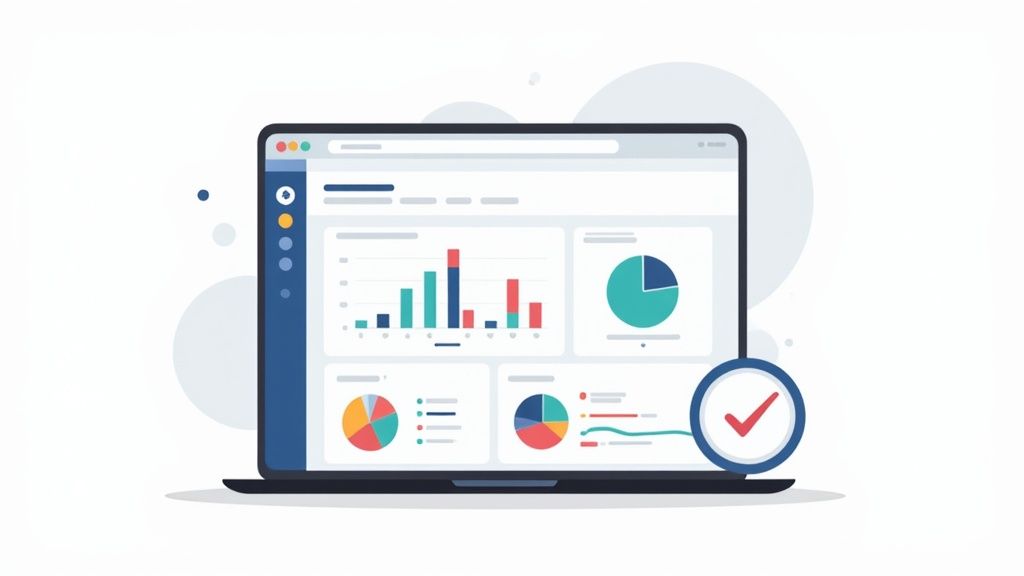
This report gives you those critical first numbers: organic keywords, monthly traffic estimates, and domain authority. They are just estimates, of course, but they’re incredibly useful for spotting trends and seeing which bits of content are pulling in the most visitors for your competitor.
I never take a single number from a free tool as absolute truth. What I look for are patterns. If a competitor’s traffic is trending up across two or three different tools, that’s a pretty strong signal that whatever they’re doing is working.
Once you combine these early insights, you can start forming a solid idea of where your competitors are winning. If you’re looking to take this a step further and automate some of the analysis, it might be worth checking out some of the best AI SEO tools available in 2025, as they can crunch this kind of data much more efficiently.
Using Premium Tools for Deeper Insights
While the free tools are great for a quick look, when you need data you can bet your budget on, it’s time to bring out the big guns. Premium platforms give you the kind of granular detail needed to make serious strategic moves. My personal toolkit is built around Ahrefs, Semrush, and SimilarWeb, and I use each for very specific jobs.
It’s less about which tool is “best” and more about which one solves the exact problem you’re facing right now. I never treat them as interchangeable; they’re specialists. Getting that distinction right is the key to figuring out your competitors’ website traffic with any real accuracy.
Choosing Your Weapon: Ahrefs vs. Semrush vs. SimilarWeb
I often find myself using two, or even all three, of these platforms to piece together the full story. Each has a core strength that I rely on for different parts of an analysis.
- Ahrefs: This is my undisputed champion for anything backlink-related. Its Site Explorer is second to none for spotting which bits of content are pulling in the most organic search traffic for a competitor. I use it to hunt down their “power pages” and reverse-engineer what makes their content and link-building tick.
- Semrush: I find Semrush is incredibly strong on the keyword and PPC front. Whenever I need to dissect a competitor’s paid search strategy or run a proper keyword gap analysis, Semrush gives me the data I need to spot quick wins.
- SimilarWeb: For pure audience intelligence, SimilarWeb is in a class of its own. If I need to understand who a competitor’s audience is, where they are geographically, or what their main referral sources are, it’s the first tool I open.
This comparison graph is a perfect example of the kind of insight you can get. It visualises not just the total visits but also the growth trajectory of two key rivals over six months.
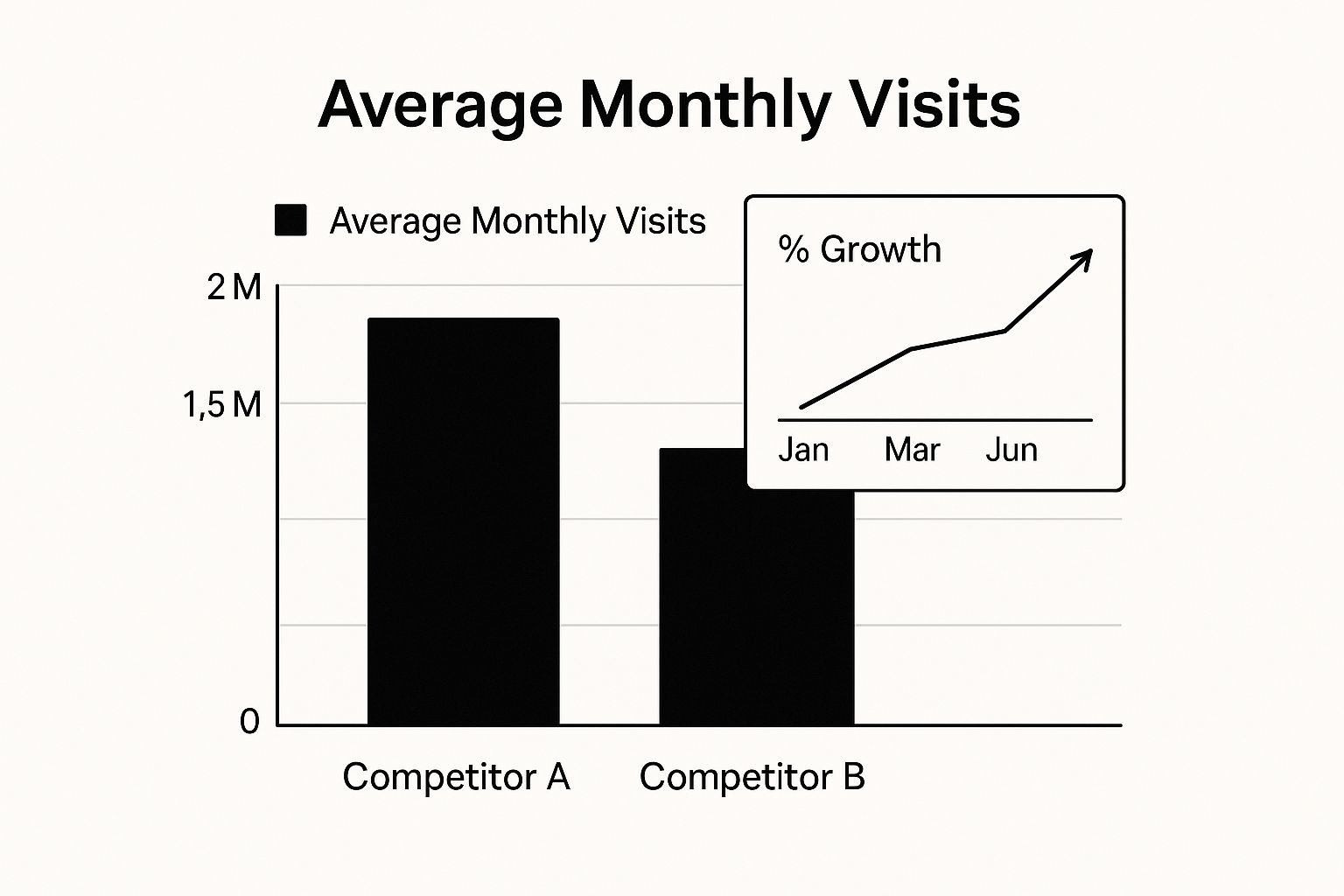
You can see straight away that while Competitor A currently gets more traffic, Competitor B is growing much faster. That’s a clear signal they’re a rising threat I need to keep a close eye on.
Premium Competitor Analysis Tool Comparison
To make it easier to decide where to start, here’s a quick breakdown of where each tool really shines. I’ve focused on their core strengths and how reliable their UK data tends to be from my experience.
| Tool | Best For | Key Metric Accuracy | UK Data Granularity |
|---|---|---|---|
| Ahrefs | Deep-diving into backlink profiles and organic content performance. | Excellent for organic traffic estimates and keyword data. | Strong, particularly for organic search insights. |
| Semrush | Comprehensive keyword research and analysing paid search (PPC) strategies. | Very reliable for PPC spend and keyword competition. | Excellent, with robust UK-specific keyword databases. |
| SimilarWeb | Broad audience intelligence, referral traffic, and demographic analysis. | Great for overall traffic trends and channel breakdowns. | Good, provides solid country-level demographic data. |
Ultimately, the best choice depends on what you’re trying to achieve. If backlinks are your priority, start with Ahrefs. If it’s all about keywords and ads, Semrush is your best bet. And for a high-level view of the entire digital footprint, SimilarWeb is fantastic.
The real power move is to layer the data from these tools. I’ll often find a top-performing page in Ahrefs, analyse its keywords in Semrush, and then check its audience demographics in SimilarWeb. This is how you turn isolated data points into a strategy that actually works.
Interpreting Key Website Traffic Metrics
Grabbing all this competitor data is one thing, but figuring out what it all means is where you’ll find the real strategic gems. When I first dive into a competitor’s profile, I zero in on a few core metrics that tell me a pretty clear story about their performance and where they’re focusing their marketing efforts.
It’s not just about knowing the definitions of unique visitors or session duration. A metric like bounce rate, for example, needs a bit more thought. A high bounce rate isn’t always a bad sign. If a competitor has a blog post that perfectly answers a very specific question, a visitor might pop in, get exactly what they need, and leave. That “bounce” is actually a win for them. A practical example is a “what is my IP address?” tool page; users arrive, get the information, and leave immediately, resulting in a high bounce rate that signifies success, not failure.
The most crucial skill in this game is understanding the context behind the numbers. Before I jump to any conclusions, I always ask myself, “What is the user actually doing to cause this metric?”
This keeps me from making the wrong assumptions and helps me figure out what really matters. It’s a key part of properly understanding how to know competitors website traffic.
Analysing Traffic Channels and Sources
A competitor’s traffic breakdown is basically a roadmap of their marketing strategy. I always break down their data by the main channels to see where they’re putting their time and money. It’s incredibly revealing.
- Organic Traffic: Heaps of organic traffic tells me their SEO and content game is strong. My next step is to dig into their top pages to see exactly which articles or landing pages are pulling in all that traffic.
- Direct Traffic: A big slice of direct traffic usually points to solid brand recognition and loyal customers. These are people typing the URL straight into their browser—a great sign for any business.
- Referral Traffic: This is a goldmine for finding out who’s linking to them. It’s one of my favourite ways to uncover potential backlink opportunities and partnerships that I might have otherwise missed.
- Social & Paid Traffic: If I see significant traffic coming from social or paid sources, I know they’re either very active on social media or are spending a decent amount on PPC ads.
Given the UK is a mobile-first market, you absolutely have to look at the device breakdown. As of late 2023, a massive 66.02% of all UK web traffic came from mobile phones. If a competitor is lagging on mobile traffic despite this trend, it might signal a poor user experience on smaller screens—a perfect opportunity for me to swoop in and grab that audience.
You can check out more of these kinds of stats on Reboot Online’s comprehensive report. A clunky mobile experience is often just a symptom of bigger problems, which you can read more about in this guide on what is technical SEO.
Putting Your Competitor Insights into Action
Gathering all this competitor traffic data is just the starting line. The real magic happens when you turn those numbers and charts into an actual, concrete growth plan. This is where I switch from just analysing to actively strategising, using what I’ve found to build a roadmap for outranking my rivals. It’s all about spotting their wins and losses and making them work for me.
The first thing I always undertake is finding a competitor’s best-performing pages. A tool like Ahrefs is perfect for this, as it shows you exactly which articles or landing pages are pulling in the most organic traffic. This isn’t about just copying their content. It’s about understanding the topics, formats, and angles that are already hitting the mark with our shared audience.
Find and Fill the Content Gaps
Once I know what’s working for them, I get straight into a content gap analysis. This is a crucial step for finding those high-value keywords your competitors are ranking for, but you aren’t. I’m on the lookout for topics where they have a foothold, but I know I can create something far better—more in-depth, more current, or with a completely fresh perspective. It’s my own spin on the ‘skyscraper’ technique.
For instance, if a rival e-commerce site is ranking well for “best running shoes for beginners,” I’m not going to just write another similar post. My goal is to create the definitive resource. I’ll aim to build a page with features like:
- Expert video reviews embedded directly on the page.
- A downloadable guide to getting the right fit.
- Side-by-side comparisons of all the latest models.
This approach ensures my content doesn’t just show up to compete; it shows up to dominate. If you’re in the e-commerce game, getting this right is non-negotiable. You can dig deeper into these kinds of strategies with these e-commerce SEO best practices for 2025 success.
Uncover Partnership Opportunities
Finally, I take a deep dive into their referral traffic data. Honestly, this is an absolute goldmine for finding new backlink and partnership opportunities. Seeing which websites send them the most visitors tells me exactly who their key allies are.
By analysing who links to your competitors, you are essentially getting a ready-made list of high-relevance websites to approach for your own brand.
From there, I’ll reach out to these sites, armed with my superior content, and offer them a more valuable resource to link to. It’s a surprisingly effective way to build authority and start siphoning off some of that high-quality referral traffic for yourself.
A Few Common Questions
I get asked about competitor traffic analysis all the time. Here are my answers to the most common questions that pop up, especially for those just getting started.
How Accurate Are These Traffic Tools?
Think of them as educated estimates, not gospel. Tools like SimilarWeb and Ahrefs use sophisticated data sampling and algorithms to model a website’s traffic. While they’re never going to be 100% precise, they are absolutely invaluable for spotting trends, understanding a competitor’s strategy, and making your own plans.
My personal rule of thumb? Always cross-reference data from at least two different tools. It helps you get a much more balanced and realistic picture.
Can I See Traffic for a Specific Page on a Competitor’s Site?
You bet. This is where premium tools like Ahrefs and Semrush really shine.
They usually have a ‘Top Pages’ report (or something similar) that shows you exactly which pages are pulling in the most organic search traffic. It’s a goldmine for figuring out what content is working for them so you can create something even better.
Is It Actually Legal to Check a Competitor’s Website Traffic?
Absolutely, 100% legal. Using these third-party tools is a completely standard and legitimate part of digital marketing. They work by analysing publicly available data signals, not by hacking into anyone’s private server. It’s all above board.
At Mersudin Forbes Digital, I focus on providing the practical SEO strategies and tool insights you need to grow your e-commerce business or marketplace. Discover more at https://mersudinforbes.com.