Marketing Automation for Small Business Growth

Marketing automation, in a nutshell, is about using smart software to handle those repetitive marketing jobs that eat up your day. Think sending emails, posting on social media, or following up on leads. For a small team like mine, it felt like hiring a digital assistant who works around the clock to keep customers engaged. It freed me up to actually focus on growing the business.
This isn’t just about efficiency; it’s about delivering timely, personalised communication at a scale that was once only possible for big companies. It’s your secret weapon for competing in a crowded market.
Why Your Small Business Needs Marketing Automation
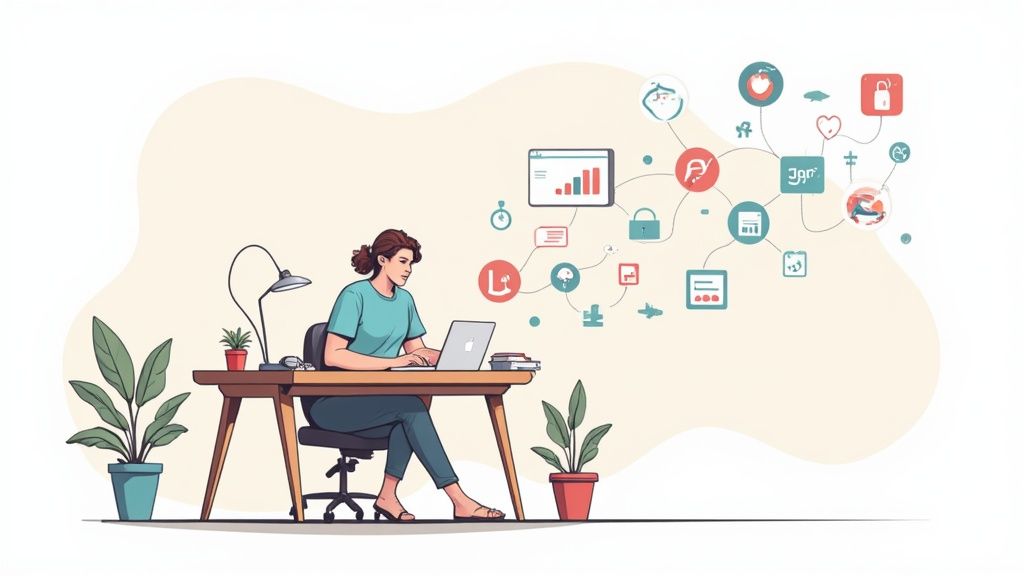
When I first started my business, I quickly realised that time is the one resource I can never, ever get back. I was constantly stretched thin, juggling client work, finances, and marketing. My so-called “marketing plan” was often just a series of last-minute, reactive tasks rather than a coherent strategy. Sound familiar?
This is where marketing automation became a complete game-changer for me. It’s not some ridiculously complex system reserved for massive corporations; it’s a practical toolkit for survival and growth. For instance, just think about all the hours you spend manually sending welcome emails, chasing up website enquiries, or just trying to remember who you need to follow up with. Automation takes over these crucial, but mind-numbing, jobs.
From Manual Grind to Strategic Growth
Before I took the plunge, my process was total chaos. A new lead would fill out a contact form, and it was on me to remember to email them back, add them to my mailing list, and then set a reminder to check in again later. It was clunky and, if I’m being honest, things definitely fell through the cracks.
Now, that same process is automated. A new lead instantly gets a personalised welcome email, is added to a specific nurturing sequence, and my CRM is updated without me lifting a finger. This guarantees every single lead gets a consistent and professional experience, whether it’s 2 PM or 2 AM.
The biggest lightbulb moment for me was this: Marketing automation isn’t about replacing the human touch. It’s about automating the mundane so I have more time for the meaningful, strategic conversations that actually close deals and build real relationships.
Punching Above Your Weight in a Competitive Market
The UK is a bustling hub for small businesses. In fact, as of early 2025, there are around 5.5 million private-sector businesses, and an incredible 99% of them are small. In a marketplace this packed, you need a competitive edge, and that edge is efficiency.
Recent statistics show that 95% of small businesses are already using at least one tech platform to stay ahead of the curve. You can dig into more stats about how UK small businesses are adopting tech over at Airwallex.com.
For my business, getting started with automation delivered three core benefits almost immediately.
Core Benefits of Marketing Automation for Small Businesses
Putting an automation system in place can feel like a big step, but the payoff is immediate and tangible. Here’s a breakdown of what you can expect.
| Benefit Area | Practical Impact for a Small Business | Example Automation Task |
|---|---|---|
| Time Savings | Frees you from repetitive manual tasks, allowing more focus on strategy and client relationships. | Automatically send a welcome email series to new subscribers. |
| Consistency | Ensures every lead and customer receives a consistent, professional brand experience. | Trigger a standard follow-up sequence after a contact form submission. |
| Lead Nurturing | Warms up potential customers around the clock, moving them closer to a purchase decision. | Send targeted content based on a user’s website behaviour (e.g., visited pricing page). |
| Data & Insights | Provides clear data on what’s working, enabling smarter, faster marketing decisions. | Track email open rates and click-throughs to see which messages resonate most. |
Ultimately, marketing automation levels the playing field. It gives a small team the power to perform with the precision and efficiency of a much larger one, which has a direct and positive impact on your bottom line.
Choosing the Right Automation Tools on a Budget
I’ve been there. Staring at a sea of automation software, all promising the world. The market is absolutely flooded with platforms, but for a small business, the decision nearly always boils down to one thing: budget.
It’s so easy to get dazzled by complex, feature-heavy tools. The problem is you can end up paying a premium for enterprise-level functions you’ll simply never touch. I quickly learned to cut through the noise by homing in on the essential features my business actually needed to get off the ground.
Define Your Core Needs First
Before you even glance at a pricing page, you need a crystal-clear idea of what you’re trying to achieve. A tool that’s a game-changer for a B2B service company might be totally useless for an e-commerce shop. Your business model really dictates your priorities here.
Start by asking yourself a few simple questions:
- What’s my number one goal? Are you trying to generate fresh leads, nurture existing contacts, or maybe recover abandoned shopping carts? Pinpoint your main objective.
- What’s my biggest time-sink? Identify the single most tedious manual task you want to get rid of. For a lot of us, it’s sending out welcome emails or follow-ups.
- What am I already using? Your new tool has to play nicely with your existing website platform (like Shopify or WordPress) and any CRM you might have in place.
For instance, when my focus was on B2B lead generation, a seamless link between my website forms and an automated email nurturing sequence was non-negotiable. An e-commerce business, on the other hand, would see abandoned cart recovery emails as a must-have to claw back lost revenue.
Comparing Popular Platforms for UK Small Businesses
Once you know what you need, you can start weighing up your options. Many platforms offer fantastic ‘freemium’ or low-cost plans that are perfect for dipping your toes in the water. I’ve personally used several, and a few consistently stand out for small businesses.
This screenshot of HubSpot’s visual workflow builder is a great example of how you can map out a customer journey.
It shows how you can build simple “if/then” branches to send different messages based on what a user does, making your marketing far more relevant.
Let’s do a quick comparison of three popular choices in the UK.
| Tool | Best For | Key Strength | Starting Price |
|---|---|---|---|
| HubSpot | All-in-one beginners | Its free CRM and marketing tools are incredibly generous, giving you a solid foundation to build on. | Free tier available |
| Mailchimp | Simple email automation | The interface is very intuitive and user-friendly, which makes creating beautiful email campaigns a breeze. | Free tier available |
| ActiveCampaign | Growing businesses | Offers powerful and sophisticated automation workflows that can scale as your needs get more complex. | Paid plans only |
If I could give one piece of advice, it would be this: start small. Pick a platform with a strong free or entry-level plan. This lets you master the basics of marketing automation for small business without the pressure of a hefty monthly subscription. You can always upgrade as your business—and your confidence—grows.
Look Beyond the Obvious Features
When you’re picking a tool, it’s not just about the core automation features. Things like scalability and ease of use are just as important. A platform that feels intuitive to you is one you’ll actually stick with. Most offer free trials, so take the time to build a test workflow and see how it feels.
It’s also worth thinking about the ecosystem of tools you’re building. For a wider look at how different platforms can fit into your overall strategy, you might find my guide on the 12 best digital marketing tools to use in 2025 helpful. Choosing tools that integrate well will save you a world of headaches later on.
Ultimately, the ‘right’ tool is the one that fits your budget and operational needs today while giving you a clear path to grow. Don’t pay for the business you hope to have in five years; pay for the one you have now and choose a platform that can evolve right alongside you.
Right, we’ve covered the tools. Now for the fun part: putting them to work and seeing a real return on your time.
Getting started with automation can feel like a big deal, but I’ve learned that focusing on a few high-impact sequences is the fastest way to get results.
I’m going to walk you through three absolute must-have workflows for any small business. These are the ones that deliver immediate value, whether that’s making a killer first impression, winning back lost sales, or making sure a new lead never falls through the cracks.
The diagram below maps out the core steps I follow for any new automation. It’s a simple process, but it works.
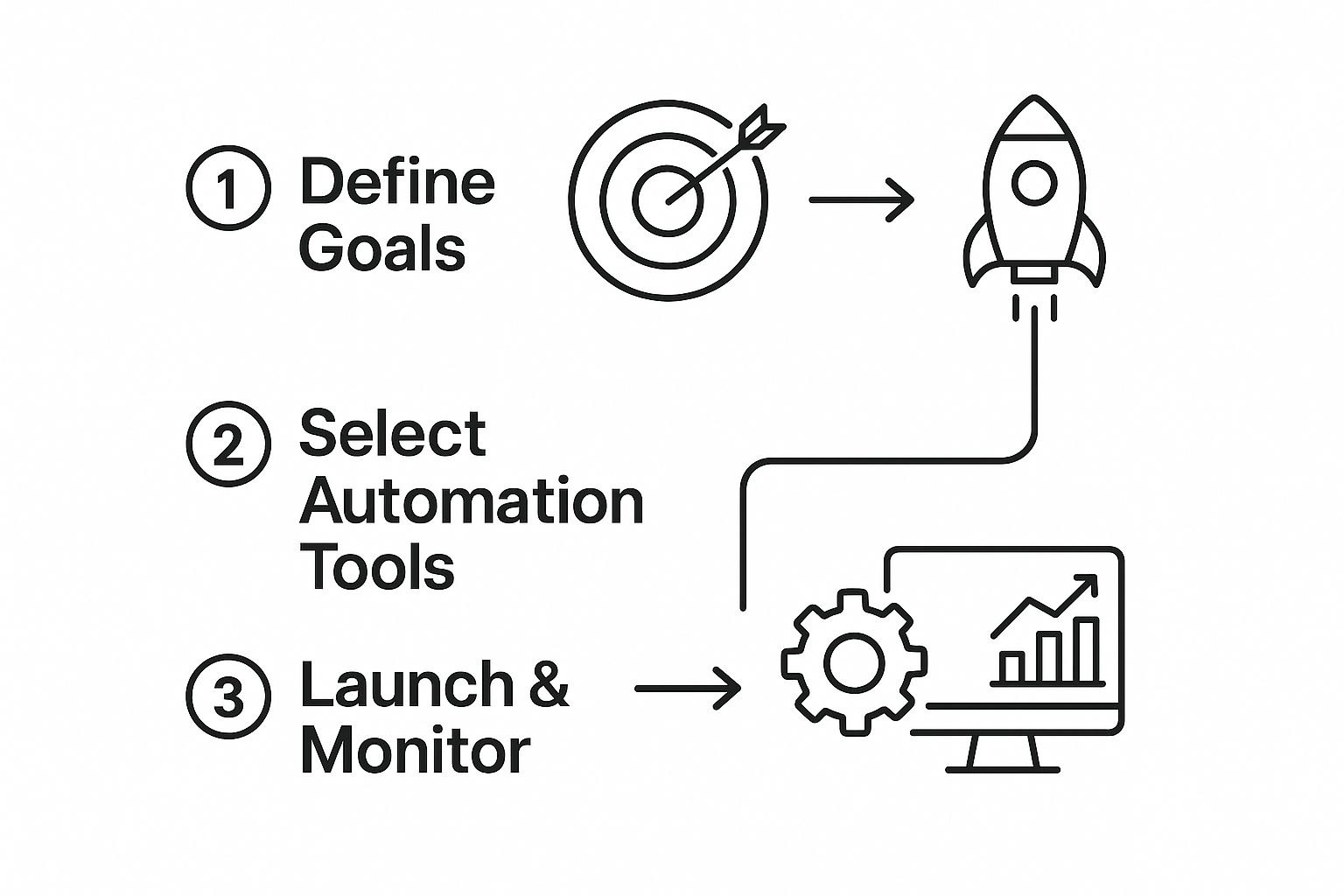
It all boils down to this: start with a clear goal and keep an eye on the results to make sure it’s actually doing its job.
Workflow 1: The Welcome Series
Your welcome series is, without a doubt, the most important automation you will ever build. Think about it – a new subscriber is never more engaged than in the moments after they sign up. This is your golden opportunity to make a connection, set the right tone, and tell them what you’re all about.
I find a simple three-part sequence, spaced out over a few days, works best.
- Email 1 (Sent Immediately): This one needs to be instant. Deliver the goods – the discount code, the free guide, whatever you promised. Add a warm, personal welcome, but keep it short and sweet. The focus is on immediate value. For example, a bakery could send an instant 10% off voucher, while a consultant could send a link to download a popular case study.
- Email 2 (Sent 2 Days Later): Now you can share a bit more about your brand’s mission or even your personal story. This is how you start building a human connection that goes beyond just a transaction.
- Email 3 (Sent 4 Days Later): The goal here is to get them involved. Point them to your best blog posts, invite them to follow you on social media, or ask a simple question to get a reply.
The point isn’t to hard-sell from the get-go. It’s about starting a conversation and building a proper relationship from day one.
Workflow 2: The Abandoned Cart Sequence
If you sell anything online, this is non-negotiable. An abandoned cart rarely means a “no.” More often than not, life just got in the way. A timely, gentle nudge is often all it takes to bring people back to finish what they started.
My abandoned cart sequence is also a three-parter, but it’s much more direct.
- Email 1 (Sent 1 Hour After Abandonment): A simple, helpful reminder. “Did you forget something?” Keep the tone light, not pushy. Always include a picture of the item(s they left and a direct link back to their cart.
- Email 2 (Sent 24 Hours Later): Here, you can create a bit of urgency or handle common objections. I sometimes drop in a customer testimonial or answer FAQs about shipping and returns.
- Email 3 (Sent 3 Days Later): This is the final nudge. If you really want the sale, now’s the time for a small incentive. A 10% discount or free shipping can often be the final push they need.
I’ve found that the first email, sent within an hour, recovers the most sales. Speed is absolutely of the essence here.
Workflow 3: The Lead Nurturing Follow-Up
What happens when someone fills out your contact form? If the answer is, “I try to email them back when I get a chance,” this workflow will be a game-changer. An automated sequence ensures every single enquiry gets a prompt, professional response, keeping them warm until I can make personal contact.
This is a big deal, because solid marketing automation for small business in the UK really comes down to a few key things: CRM integration, email triggers based on behaviour, lead scoring, and good old-fashioned analytics. If you want to dive deeper, there are some great insights on how this helps UK businesses over at Digital Business Transformation.
My lead nurturing workflow is all about bridging that gap between their initial interest and an actual sales chat.
- Immediate Auto-Reply: The second they hit ‘submit’, an email lands in their inbox confirming you got their message. It sets expectations by letting them know when to expect a personal reply (e.g., “within 24 business hours”).
- Follow-Up with Resources (2 Days Later): If you haven’t managed to get in touch yet, the system sends another email with something valuable. This could be a relevant case study, a helpful blog post, or a link to your portfolio. It keeps you top-of-mind and shows off your expertise.
- Final Check-In (5 Days Later): One last friendly email asking if they still need help. You’d be surprised how often this prompts a reply and makes sure no one slips through the cracks.
To make this clearer, let’s compare these three essential workflows side-by-side.
Essential Automation Workflow Comparison
| Workflow Type | Primary Goal | Common Trigger | Success Metric (KPI) |
|---|---|---|---|
| Welcome Series | Build a relationship & set expectations | New email list subscription | Open rates, click-through rates |
| Abandoned Cart | Recover potentially lost sales | A user adds items to a cart but doesn’t check out | Cart recovery rate, revenue recovered |
| Lead Nurturing | Keep potential clients warm & engaged | A user submits a contact or enquiry form | Reply rates, leads converted to clients |
Each of these workflows is pretty simple to set up, but together they create a powerful and consistent experience that builds trust and, ultimately, drives revenue. They’re the perfect place to start.
Using AI to Supercharge Your Marketing Automation
Once you’ve got your automated workflows running, adding a layer of Artificial Intelligence (AI) can honestly feel like a superpower. AI isn’t some ridiculously complex tech reserved for massive corporations anymore; it’s now a genuinely practical tool that makes your marketing smarter and a whole lot more effective.
I’ll admit, the whole concept of “AI” felt a bit much when I first started exploring it. But I quickly realised it’s just about using clever software to do very specific jobs, much better than I could. Now, I use AI every single week to brainstorm content ideas and draft social media posts. That alone saves me a few hours of work, easy.
Going Beyond Basic Automation
Your standard automation follows the rules you set for it. Think: “if a user abandons their cart, send this specific email.” Simple and effective.
AI, on the other hand, can dig into your data to make its own decisions and predictions. It’s brilliant at spotting patterns in customer behaviour that you or I would almost certainly miss.
This opens up a level of personalisation that basic workflows just can’t touch. An AI-driven system can start predicting which products a customer might buy next, or tell you which of your leads are giving off the strongest buying signals.
My biggest takeaway has been this: AI helps you move from reactive marketing (responding to actions) to predictive marketing (anticipating customer needs). It’s a fundamental shift in how you can approach your entire strategy.
UK businesses are catching on fast. A 2025 survey from Constant Contact found that 92% of UK SMEs trading for five years or less see technology as essential to their growth. Even more telling, 72% plan to use AI specifically for marketing this year. You can dive into the details yourself in their full UK SMB report.
Practical AI Applications for Your Business
Let’s skip the tech jargon and look at some real-world uses that can actually make a difference to your small business. These are all things you can start trying out today.
- Smarter Email Subject Lines: I’ve played around with several AI subject line generators. They analyse mountains of data to spit out options with the best chance of getting opened. It’s a tiny change, but it gave my open rates a measurable boost.
- Predictive Lead Scoring: Instead of just counting clicks, AI tools can look at dozens of data points to score your leads. This is a game-changer for focusing your sales efforts on the people most likely to actually convert.
- AI-Powered Content Creation: Tools like Jasper or Copy.ai are a massive help for getting over writer’s block. I often use them to generate a rough blog post outline or create a bunch of different ad copy versions for testing. It just speeds the whole process up.
If you’re keen to see what else is out there, my guide to the 12 best AI tools for marketing in 2025 covers some of my top recommendations in more detail.
Getting Started with AI on a Small Scale
You really don’t need to rip out your entire system to get the benefits of AI. A lot of the marketing automation platforms popular with small businesses are already building AI features directly into their existing plans.
Keep an eye out for tools that offer things like:
- AI Writing Assistants: These are often built right into the email or social media composer.
- Predictive Sending Times: Some tools can analyse when your audience has engaged in the past to recommend the best time to send an email.
- Smart Segmentation: This is where AI automatically groups your contacts based on their predicted behaviour, not just things they’ve already done.
The key is to just start small. Pick one or two specific things you want to improve. By using this kind of affordable, intelligent tech, you can make your existing marketing automation for small business more insightful, personal, and ultimately, more profitable.
How to Measure Your Automation Success and ROI
Getting your first automation workflows live is a huge milestone, but it’s really just the starting line. The real magic happens when you start figuring out what’s working, what’s falling flat, and why. I learned this the hard way – if you’re not measuring, you’re just guessing.
Working out the return on investment (ROI) from your marketing automation for small business doesn’t have to be a headache. It’s all about tuning out the noise and zeroing in on the numbers that actually make a difference to your bottom line.
Moving Beyond Vanity Metrics
It’s so easy to get obsessed with ‘vanity metrics’ – things like email open rates or social media likes. They look good on a report, but they don’t pay the bills. I made this mistake early on, getting excited about high open rates without asking the important question: were they actually leading to sales?
Now, I focus my energy on the metrics that are directly tied to revenue. These are the numbers that tell you if your investment in time and money is actually paying off.
Here are the key metrics I watch like a hawk:
- Conversion Rate per Campaign: This is the big one. What percentage of people who went through a specific workflow (like a welcome email series) actually made a purchase or booked a call?
- Lead Quality Improvement: Are the leads coming through your automated funnels better than before? A higher lead-to-customer conversion rate tells you your nurturing is doing its job.
- Customer Lifetime Value (CLV): Are your automated up-sell or cross-sell campaigns bringing customers back for more? A rising CLV is a fantastic sign that your automation is building genuine loyalty.
- Sales Cycle Length: How long does it take to convert a new lead into a paying customer? Good automation should shorten this cycle by delivering the right message at the right time.
Getting Familiar with Your Analytics Dashboard
Most marketing automation platforms come with a built-in analytics dashboard. This needs to become your new best friend. Don’t get overwhelmed by all the graphs and data; your job is to find the story hiding in the numbers.
I make it a habit to check my dashboards at least once a week, looking for trends or anything unusual. For instance, if I spot a sudden drop in click-through rates on my abandoned cart emails, I know it’s time to dig in. Maybe the copy needs a refresh, or the offer isn’t compelling enough.
Having solid data is also vital for your wider digital marketing. Many of the best SEO tools for small business in the UK depend on accurate analytics to inform strategy.
Your goal isn’t just to glance at the numbers; it’s to constantly ask “why?” Why did this campaign outperform the last one? Why are leads from one source converting faster than another? The dashboard gives you the clues, but your insights drive the improvements.
The Power of Simple A/B Testing
Once you start digging into your data, you’ll naturally start having ideas and questions. This is where A/B testing comes into play. It sounds technical, but it’s just a simple experiment to see which version of something works better.
You can A/B test pretty much anything in your workflows. I’ve found that even tiny tweaks can lead to some surprisingly big wins.
Here are a few simple tests every small business should try:
- Subject Lines: Test a direct subject line (e.g., “Your Guide is Inside”) against one that sparks curiosity (e.g., “A little something to get you started…”).
- Call-to-Action (CTA): Try changing the text on your main button. Does “Shop Now” work better than “Explore the Collection”?
- Timing: For something like an abandoned cart sequence, does sending the first email after one hour convert better than sending it after four hours?
Most automation tools make setting up these tests incredibly simple. You just create two versions (A and B), and the software automatically shows each one to a portion of your audience. It then tells you which one won based on the metric you care about, like click-throughs or conversions.
This constant cycle of measuring, analysing, and testing creates a powerful feedback loop. It turns your marketing automation from a ‘set and forget’ tool into a dynamic system that’s always getting smarter, ensuring it becomes more effective and profitable over time.
Common Questions About Marketing Automation
Whenever I talk about marketing automation, the same questions always pop up. I get it. For a small business owner, it can sound expensive, complicated, and a massive time sink before you see any real results.
It’s completely normal to feel a bit cautious. Jumping in can feel like a big commitment, so I want to clear up a few of the most common worries right now. Here are the straight answers to help you get started with a bit more confidence.
How Much Does Marketing Automation Cost?
This is always the first question, and the answer is surprisingly flexible: it can cost absolutely nothing to get started. Many of the big players, like Mailchimp and HubSpot, have brilliant free plans that are more than powerful enough to begin with.
These free tiers usually let you set up basic email workflows and manage a set number of contacts. When I was starting out, this was the perfect way to test the waters. I was able to prove the concept worked for my business and see a real benefit without spending a single penny.
A big mistake I see people make is jumping straight to the most expensive, feature-heavy plan. You don’t need it. Start free or cheap, cover the basics, and only upgrade when your business has grown enough to actually need the extra features.
When you’re ready for a paid plan, you’re typically looking at somewhere between £15 to £50 per month for tiers aimed at small businesses. The trick is to find a tool that gives you great value from the get-go, so you’re not paying for advanced functions you won’t touch for years.
How Long Does It Take to Set Up?
Honestly, you can get your first automation live faster than you probably think. A simple welcome email for new subscribers or an abandoned cart reminder can genuinely be built in an afternoon.
Most modern tools are designed for people who aren’t developers. They use simple drag-and-drop builders, so you don’t need to know a single line of code.
The part that takes a bit more time is the thinking you do before you touch the tool. Planning what your emails will say and what will trigger them requires some thought. But once you have that plan sketched out, putting it into the system is surprisingly quick.
Will It Feel Impersonal to My Customers?
This is a really important concern, especially when your business is built on that personal touch. But here’s the thing: good marketing automation for a small business actually makes your marketing more personal, not less.
Here’s why:
- You can segment properly: Automation lets you send the right message to the right person. You can group customers based on what they’ve bought or what they’re interested in. That’s a world away from blasting the same generic newsletter to everyone.
- It’s all about timing: Sending a helpful email at the exact moment it’s needed (like a thank you right after a purchase) feels thoughtful and attentive, not robotic.
- It frees you up: This is the big one. By letting the tech handle repetitive messages, you get more time back for real, one-on-one conversations with your best leads and most loyal customers.
You’re not trying to automate every single interaction. The goal is to automate the routine stuff so I can put my energy where it has the biggest impact—building genuine relationships.
Ready to stop guessing and start growing? At Mersudin Forbes Digital, I provide the expert insights and tool reviews you need to build an ROI-driven SEO and automation strategy that truly works. Visit mersudinforbes.com to get started.