What Is Programmatic Advertising? A Clear Guide

Ever wondered how ads seem to follow you around the internet, almost like they’re reading your mind? The magic behind it all is called programmatic advertising.
At its core, programmatic advertising is the automated buying and selling of online ad space. Forget the old days of lengthy negotiations, endless emails, and phone calls. This is more like a high-speed stock exchange, but instead of trading shares, we’re trading digital ad placements in the milliseconds it takes for a webpage to load.
So, What Exactly Is Programmatic Advertising?
Imagine you’re at a lightning-fast auction. Instead of people shouting bids, you have sophisticated software making instant deals. That’s pretty much how programmatic advertising works. It’s an automated, data-driven system that connects advertisers (the buyers) with publishers (the sellers) to decide which ad gets shown to which person, all in real time.
But this isn’t just about speed and efficiency. It’s about being incredibly precise. The whole point is to show a specific ad to a specific user at just the right moment. For a practical example, think about why you see an advert for a pair of Nike trainers right after you’ve been browsing a sports website like Sports Direct. The system knows you’re interested, making the ad far more relevant and effective.
The Sheer Scale of Automation in the UK
This move towards automation isn’t just a passing trend; it’s completely changed how ads are bought and sold. The numbers in the UK tell a very clear story. By early 2025, digital ad investment rocketed to around £38.07 billion, with digital platforms soaking up over 80% of the UK’s entire ad spend. It’s a massive shift towards automated, data-focused advertising.
The diagram below gives you a bird’s-eye view of how all the different pieces of the programmatic puzzle fit together to make this real-time bidding happen.
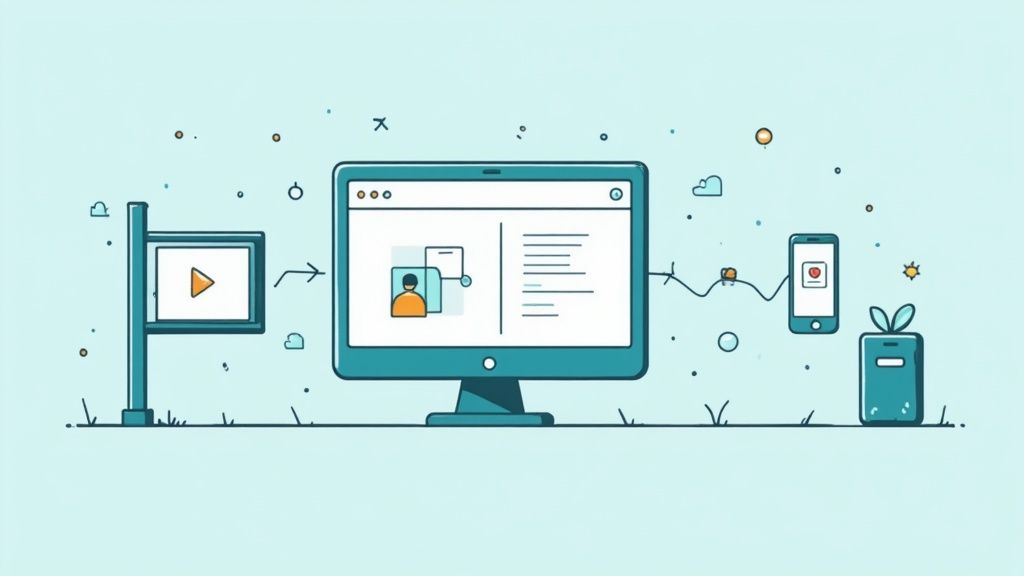
As you can see, it shows the journey from the advertiser to the publisher, with ad exchanges and other tech platforms sitting right in the middle, making the whole thing work seamlessly and instantly.
The Key Players in Programmatic Advertising
To really get your head around it, it helps to know who’s involved. We’ll dive deeper into each of these later, but for now, here’s a quick rundown of the main components.
Programmatic advertising isn’t about buying ads on the cheap; it’s about buying them smarter. It lets advertisers find their perfect audience with incredible accuracy, so every penny is spent reaching people who actually care.
Before we get into the nitty-gritty, this table summarises the key players you’ll hear about.
Programmatic Advertising at a Glance
| Component | What It Is |
|---|---|
| Advertisers | The brands and businesses looking to promote their products or services. A real-world example would be a company like British Airways. |
| Publishers | The website or app owners with ad space available to sell, such as The Guardian or a popular mobile game. |
| Demand-Side Platform (DSP) | The software advertisers use to purchase ad space from multiple sources automatically. Popular DSPs include The Trade Desk and Google DV360. |
| Supply-Side Platform (SSP) | The software publishers use to manage and sell their ad space automatically. Xandr and Magnite are common examples. |
| Ad Exchange | The digital marketplace where DSPs and SSPs meet to auction off ad space in real time, like Google’s Ad Exchange. |
These components form the backbone of the entire ecosystem.
Each player has a specific role, from the brand with a message to the website with an audience. To see how these principles apply in a real-world platform, it’s worth understanding Meta Ads, which uses very similar automated, data-driven methods to deliver ads to its billions of users.
How Programmitic Advertising Actually Works
Let’s pull back the curtain and see what’s really going on behind the scenes. It might seem like magic, but the whole process unfolds in the time it takes you to blink, turning a simple website visit into a highly specific ad experience. It’s a fast-paced dance with a few key players, but it follows a pretty logical sequence.
Imagine you fancy a browse on a popular UK news website like the BBC News homepage. The second your browser starts loading the page, the publisher’s website sends out a signal. This is basically an open invitation for advertisers to bid on the empty ad space on that page. The signal also carries some anonymous info about you—things like your location, the device you’re on, and your recent browsing habits.
The Automated Bidding Kicks Off
This is where things get really interesting. The publisher’s Supply-Side Platform (SSP) catches this signal. You can think of an SSP as an estate agent for the publisher; its main job is to manage all the ad space and squeeze the best possible price out of it. The SSP then offers this ad space up on an Ad Exchange, which is just a massive, real-time digital marketplace.
At the same time, advertisers who want to reach someone just like you have already set up their campaigns using a Demand-Side Platform (DSP). A DSP acts like a savvy personal shopper for the advertiser. It’s constantly scanning the ad exchanges for the perfect opportunity to reach a specific audience, based on criteria they’ve already defined, like interests, demographics, and online behaviour.
At the heart of programmatic is a lightning-fast auction. Multiple DSPs, each representing different brands, size up the ad opportunity. If your profile is a match for their target audience—say, a man in Manchester who recently searched for running shoes—they’ll place a bid.
This whole auction is what we call Real-Time Bidding (RTB). The Ad Exchange runs the auction, and the DSP that bids the highest wins the right to show its ad to you.
From Winning Bid to Ad Display
Once the auction is won—a process that takes less than 100 milliseconds—the winning advertiser’s ad is instantly pulled in and displayed on the news site you’re still loading. This entire operation is fuelled by data, which is often wrangled by a Data Management Platform (DMP). A DMP is a bit like a data library; it collects, organises, and activates audience data from all sorts of places to help advertisers make smarter, more informed bids. For example, Oracle’s BlueKai is a well-known DMP that provides third-party data to help advertisers enrich their targeting.
This infographic breaks down the core steps, from the advertiser setting up their campaign right through to the final ad being delivered to the user.
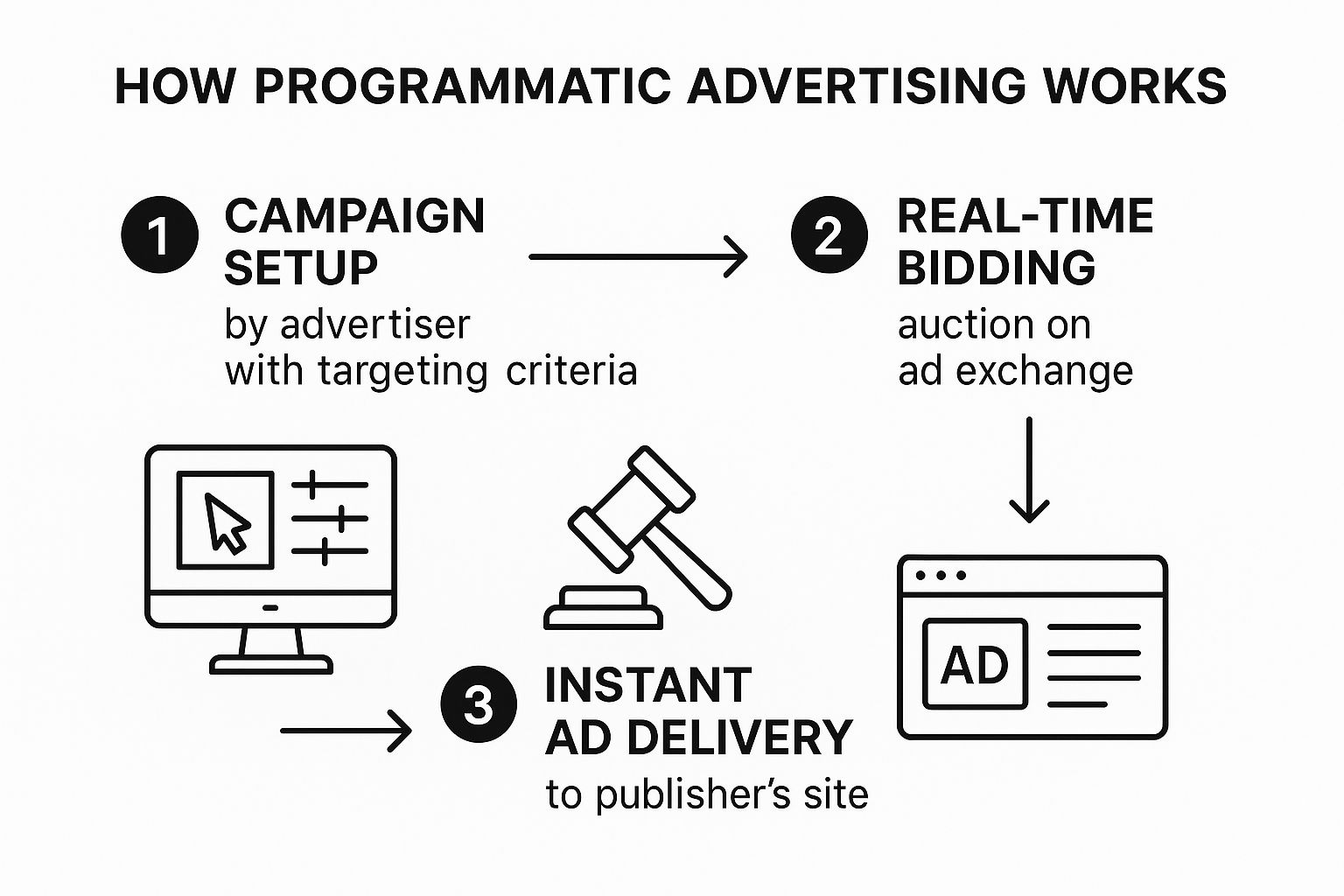
As you can see, the process is almost entirely automated. Technology handles the real-time auction and makes sure the most relevant ad wins the spot, all in an instant. It’s a remarkably efficient system that connects all the dots between a user’s click, an advertiser’s goal, and a publisher’s available space.
Exploring the Different Types of Programmatic Deals

When you hear “programmatic advertising,” you might picture one massive, chaotic auction. But that’s not the full story. There are actually several different ways to buy ad space, and each one serves a very different strategic purpose.
Choosing the right deal type is crucial for hitting your campaign goals, whether you’re aiming for maximum reach across the web or guaranteeing your ad appears on a single, high-profile website.
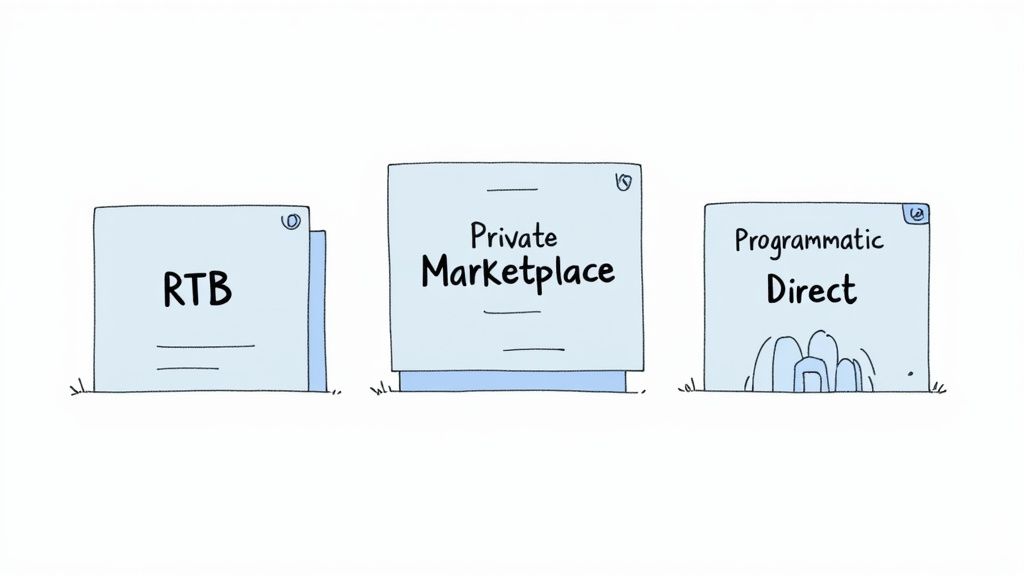
The most familiar setup is Real-Time Bidding (RTB). Think of it as a completely open, public auction where ad impressions are sold off to the highest bidder in the blink of an eye. This open market is brilliant for casting a wide net, reaching new audiences, and getting competitive pricing.
Sometimes, though, you need a bit more control over where your brand shows up. That’s when the more exclusive deal types come into their own, giving you a step up in quality and priority.
Private Marketplace Deals
A Private Marketplace (PMP) is like an invitation-only auction. It’s the VIP room of programmatic, where a publisher invites a select group of advertisers to bid on their best ad space before it ever hits the open market. This gives you much better transparency and control.
Imagine a luxury travel brand like a Four Seasons hotel. They could use a PMP to secure ad placements exclusively on upmarket travel blogs like Condé Nast Traveler and premium publications. It ensures their brand appears in a relevant, safe environment, reaching the perfect audience without having to shout over everyone in the public auction.
The UK’s programmatic scene is particularly advanced, making these sophisticated deal types widely available. In fact, projections show UK programmatic ad spend is set to hit nearly $23.19 billion by 2025—almost double that of Germany and France put together.
Preferred and Guaranteed Deals
For even more control, there are Preferred Deals. This gives an advertiser the first look at a publisher’s ad space at a fixed price that you’ve both agreed on beforehand. If the advertiser passes on the impression, it then goes to the private or open auction. It’s a great model for predictable pricing without locking yourself into a huge buy. A practical example is a car manufacturer like Audi arranging a preferred deal with What Car? to get first refusal on banner space.
Finally, you have Programmatic Guaranteed. This is the most direct and secure deal, essentially mirroring traditional ad buying but with all the efficiency of programmatic technology.
- Fixed Placements: You and the publisher agree on a specific number of impressions.
- Fixed Price: The cost is locked in, so there are no surprises from auction dynamics.
- Guaranteed Delivery: The publisher guarantees your ad will be shown the agreed-upon number of times.
This approach is ideal for big-impact campaigns where getting your ad on a top-tier site is non-negotiable, such as a major film studio launching a blockbuster and wanting a guaranteed homepage takeover on a site like IMDb.
Ultimately, picking the right deal comes down to your campaign goals. It’s just like doing detailed keyword research to find the right terms; you need to choose the right programmatic deal to target your audience effectively. To learn more about that process, check out our guide on how to do keyword research for your campaigns.
So, What Are The Key Benefits For Your Business?
It’s one thing to get your head around the mechanics of programmatic advertising, but the real magic happens when you see what it can actually do for your business. Once you look past the technology, you find a powerful, automated engine that can genuinely improve how you find customers and where you spend your marketing pounds.
One of the first things you’ll notice is just how much more efficient everything becomes. Think about the old way of buying ad space – it was a grind of phone calls, back-and-forth emails, and tedious negotiations. Programmatic sweeps all that off the table. It frees up your team from the boring admin, letting them focus on what really matters: strategy, creative ideas, and digging into the results.
Laser-Focused Targeting and Broader Reach
Programmatic gives you an almost unbelievable amount of control over who sees your ads. You’re no longer just buying a slot on a website and crossing your fingers that the right people show up. Instead, you’re buying direct access to specific people based on their interests, their online habits, and who they are, no matter which website they happen to be visiting. That means less wasted budget and more meaningful connections.
Picture a small, independent coffee shop in Bristol. With programmatic, they could run a lunch deal advert shown only to people on their phones, within a two-mile radius of the shop, and only between 11 AM and 2 PM. That’s the power of geotargeting and dayparting in action—hitting the right person, in the right place, at the perfect time.
Real-Time Data and On-The-Fly Optimisation
Another massive win is the instant access to performance data. With traditional ad campaigns, you often had to wait weeks to find out if they even worked. Programmatic gives you live feedback, so you can make smart changes as you go.
For instance, a retailer could launch a campaign with five different ad creatives. After just a few hours, they might see in their DSP dashboard that one creative has a click-through rate that’s double the others. They can immediately pause the underperforming ads and reallocate the budget to the winner, maximizing their return on investment in real time.
It’s no surprise that more and more businesses are catching on. The UK programmatic advertising market is expected to grow at a compound annual rate of around 27% between 2025 and 2035. That’s a huge signal of just how vital this approach is becoming. You can find more details in this market research on the UK programmatic sector.
This data-driven method helps everyone from local businesses to massive corporations make smarter, faster marketing decisions. Getting the most out of these insights often means using the right tools; for a closer look at some great analytics platforms, check out our guide on tools like Semrush.
Navigating Common Challenges and Pitfalls
While programmatic advertising is incredibly powerful, it’s not a “set it and forget it” machine. To get a great result, you need to be aware of a few potential hurdles right from the start. Knowing what to look out for helps you manage your campaigns proactively, protect your budget, and make sure your brand shows up exactly how you want it to.
The biggest issue people talk about is ad fraud. This is where bots, not actual humans, generate fake clicks or impressions, which just burns through your ad spend. According to a 2023 report from Statista, digital ad fraud costs advertisers an estimated $81 billion globally. It’s a massive problem that takes a mix of good technology and just paying attention.
Another major thing to keep on your radar is brand safety. You’ve spent ages crafting the perfect ad for a family holiday; the last thing you want is for it to appear next to offensive or dodgy content. Without the right controls in place, automated placements can sometimes put your brand in the wrong neighbourhood online, which can seriously damage your reputation.
Tackling Fraud and Ensuring Brand Safety
The good news is that the industry has developed some solid tools to deal with these problems. Most decent Demand-Side Platforms (DSPs) have built-in fraud detection that automatically filters out shady bot traffic. You can also team up with third-party verification services like DoubleVerify or Integral Ad Science (IAS) for an extra layer of security.
For brand safety, your best line of defence is to create really thorough exclusion lists. These are simply lists of websites, apps, and content categories where you tell the system never to show your ads. A few key tactics I use are:
- Blacklists: Pinpointing specific domains you want to avoid completely.
- Whitelists: This is the opposite approach, where you only allow your ads to run on a pre-approved list of high-quality sites you trust.
- Keyword Exclusions: Stopping your ads from showing up on pages that contain negative or sensitive keywords (e.g., “crash,” “disaster,” “scandal”).
Programmatic advertising isn’t just about automation; it’s about controlled automation. When you actively manage where your ads appear and who sees them, you can cut down the risk and get the most impact from every pound you spend.
Preparing for a Cookieless Future
The final big challenge on the horizon is the move away from third-party cookies. Browsers like Chrome are phasing them out because of privacy concerns, which means the old-school ways of tracking people across the web are on their way out.
This forces advertisers like us to adapt. The focus is now shifting to privacy-friendly solutions like contextual targeting, where ads are placed based on what’s on the page, not a user’s browsing history. For example, a kitchenware brand like Le Creuset could target articles about home cooking or recipes for stews. These new approaches mean we have to rethink targeting, a topic we cover a lot in our collection of expert SEO tips and digital marketing advice. It’s a pivot that ensures you can still run brilliant campaigns while respecting everyone’s privacy.
Right, so you’re ready to dip your toes into the world of programmatic advertising. It can seem a bit daunting at first, but if you break it down into a few simple steps, it’s much more approachable. Think of this as your game plan for getting your first campaign off the ground without wasting a single pound.
First things first: you need to know what you’re trying to achieve. Before you even glance at a platform or an ad, you have to define what success actually looks like for you. What are your campaign goals and Key Performance Indicators (KPIs)? Are you chasing sales (conversions), trying to get your brand name out there (impressions), or looking for new leads (form fills)? Your answer here will shape every single decision that follows.
Choose Your Platform and Define Your Audience
Once you’ve got your goals locked in, it’s time to pick your Demand-Side Platform (DSP). This is basically your control panel for buying ad space automatically. For the UK market, you’ll come across big names like The Trade Desk, Google Display & Video 360, and Adform. Each has its own quirks and strengths, so look at things like how easy they are to use, their targeting options, and how they handle pricing.
I always tell people to think of their DSP as the engine and their audience data as the fuel. The clearer you are about who you want to reach—their demographics, what they’re interested in, and their online habits—the better your DSP will be at finding them.
With a platform chosen, you need a realistic budget. This isn’t a finger-in-the-air guess; it should tie directly back to your KPIs. For example, if you want 100 new customers and you know your average cost to get one is £15, then you’re looking at a £1,500 budget, minimum. This approach keeps your spending accountable and focused on real results. If you want to dig a bit deeper into the different platforms out there, this guide from HubSpot is a great starting point.
Finally, you need some decent ad creative. Your images and words have to be good enough to grab someone’s attention in a split second.
Your Programmatic Launch Checklist
I find checklists always help keep things on track. Here’s a quick one to get you started:
- Set Clear Goals: Decide on your main objective (e.g., sales, awareness, leads).
- Establish KPIs: Pick the actual numbers you’ll use to track success (e.g., CPA, CTR, conversion rate).
- Select a DSP: Do your homework and pick a platform that suits your budget and goals.
- Define Your Audience: Get specific about who you’re trying to talk to.
- Set a Realistic Budget: Make sure your spending aligns with what you want to achieve.
- Develop Ad Creative: Create ads that will actually make people stop and look.
Frequently Asked Questions About Programmatic Advertising
Once you get your head around the basics of programmatic advertising, a few practical questions always seem to pop up. Let’s run through some of the most common ones I hear from UK businesses.
How Much Should a Small Business Budget for Programmatic?
There’s no single magic number, but I find a good place to start is around £500 to £1,000 per month.
That’s usually just enough to get the ball rolling, gather some meaningful data, and see what’s actually working. The real key is to work backwards from your goals. If you’re aiming for a certain number of sales, figure out your target cost-per-acquisition and that will tell you what a realistic budget looks like. For instance, if you sell a product for £50 with a £20 profit margin, you might set a target CPA of £10. A £1,000 monthly budget would then aim to generate 100 sales.
A lot of platforms, like Google Display & Video 360, are flexible. You can start small and then ramp up your spending once you see a positive return. It’s all about testing and learning, not about throwing a huge chunk of cash at it from day one.
What Is the Difference Between Programmatic and Google Ads?
Think of it this way: Google Ads, especially the Search side, is all about capturing immediate intent. Someone types a keyword into Google, and your ad shows up. It’s brilliant for that.
Programmatic advertising, on the other hand, casts a much wider net. It buys ad space across the entire web – websites, apps, video platforms, you name it. It makes these decisions based on audience behaviour and data, not just the keywords someone is typing in right now.
While Google’s own Display Network is technically a type of programmatic, using a dedicated DSP gives you access to a far bigger pool of ad space and much more advanced targeting that goes way beyond Google’s own playground.
How Will the End of Third-Party Cookies Impact Campaigns?
The move away from third-party cookies is a big deal, no doubt, but it’s definitely not the end of the world for effective advertising. The whole game is just shifting towards solutions that respect user privacy more.
What does this mean in practice? It means we’ll be relying more on:
- First-Party Data: The information you’ve collected directly from your own customers and website visitors. This is now gold dust. For example, using your email subscriber list to create lookalike audiences.
- Contextual Targeting: Placing ads where they make sense. For example, a company selling hiking boots advertising on a blog about the best trails in the Peak District.
- Identity Solutions: New tech that groups users into anonymous cohorts based on shared interests, without needing to track them individually. An example is The Trade Desk’s Unified ID 2.0.
It forces a change in strategy, for sure, but the end result is advertising that’s more transparent and a lot less creepy for everyone involved.
Ready to master your digital strategy and find the right tools to grow your business? Mersudin Forbes Digital offers expert guides, in-depth tool reviews, and actionable SEO tips to improve your online performance. Visit us at https://mersudinforbes.com to get started.