A Guide to SEO for Ecommerce Websites
SEO for e-commerce is all about getting your online shop to show up higher in search results. It’s a bit of an art and a science, really. The goal? To drive free, high-intent traffic straight to your product and category pages. Unlike chucking money at paid ads, this builds a lasting flow of customers who are actually looking for what you sell.
Why SEO Is Your Most Valuable E-commerce Channel
When I work with online retailers, I see a lot of them leaning heavily on paid ads. Platforms like Google Ads and Meta can bring in traffic fast, sure, but they’re like a tap. The second you stop paying, the visitors vanish. This is where getting your head around SEO for e-commerce websites completely changes the game.
I always tell my clients to think of SEO not as a marketing cost, but as an investment in a digital asset. Every tweak I make, whether it’s refining a product description or landing a quality backlink, adds real, long-term value to their online store. You’re essentially building a powerful engine that attracts customers 24/7, without that constant cost-per-click drain.
The True Financial Impact of Organic Search
The real magic of SEO is in its efficiency and the quality of visitors it attracts.
Think about it. Someone searching for “women’s waterproof running jacket size 12” has a crystal-clear, immediate need. If your product page pops up for that search, you’re meeting them at the perfect moment. It’s far more powerful than just interrupting their social media scrolling with an ad they didn’t ask for.
This high intent pays off. Big time. Organic search is a massive high-return channel here in the UK. Recent benchmarks I’ve seen show that SEO converts 84.62% more users than PPC campaigns. That stat alone shows you just how much better the lead quality is from organic search.
On top of that, SEO can generate an average ROI of 317% for e-commerce businesses. To put it simply, for every £1 I invest in an SEO campaign for a client, they can expect to see £3.17 back in revenue. You can dig into more stats like this over on Artios.io.
My personal philosophy is simple: SEO builds a foundation of trust and authority that paid ads just can’t buy. When Google consistently ranks your store, it’s a powerful endorsement that tells customers you are a credible and relevant choice.
At the end of the day, a solid SEO strategy gives you a few key advantages:
- Sustainable Traffic: It creates a steady stream of visitors that doesn’t rely on your daily ad budget.
- Higher Conversion Rates: Organic visitors often have a stronger intent to buy, which means better sales.
- Competitive Edge: Outranking your competition for key product terms carves out a serious slice of the market.
- Brand Authority: High rankings build trust and position your store as a go-to leader in your niche.
Laying the Groundwork with Keyword Research
Before I even dream of sketching out a site structure or tapping out a product description, I get laser-focused on keyword research. This isn’t just some SEO box-ticking. It’s the concrete foundation for any ecommerce store that actually wants to make money.
If I get this part wrong, it’s like setting up a brilliant shop in the middle of a desert with no roads leading to it. You might have the best products, but nobody will ever find you.
My first move is always to put myself in the customer’s shoes. What are they thinking? What words are they typing into Google at each stage of their journey? Someone searching for “best trail running shoes for wide feet” is in a completely different headspace to someone looking up a “Nike Pegasus Trail 4 review”.
Decoding Buyer Intent
I like to split keywords into three main buckets. It’s a simple way to make sure I’m catching people at every point in their buying journey, from casual browsing to having their credit card in hand.
- Commercial Intent Keywords: These are the big ones, the terms that signal someone is ready to buy. They’re usually loaded with words like “buy,” “deal,” “sale,” or a specific model number. For a UK trainer shop, think “buy Adidas Ultraboost online UK” or “Nike Air Max 90 sale”. These get mapped straight to my product and category pages.
- Informational Intent Keywords: This is where your future customers are hanging out, doing their homework. They’re looking for answers with searches like “how to choose running shoes for marathon” or “what is pronation”. I target these with blog posts and in-depth buying guides. It builds trust and brings people to the site who I can then guide towards a purchase. If you want to go deeper on this, check out my guide on what is keyword research and how to do it.
- Navigational Intent Keywords: These are searches for your own brand, like “Mersudin Forbes Digital”. It might seem basic, but owning that top spot for your own name is non-negotiable. It captures people who already know and trust you.
My Keyword Research Toolkit in Action
I spend a lot of my time in tools like Ahrefs and SEMrush to turn my ideas into a solid, data-backed plan. One of the classic mistakes I see all the time is people going after keywords that are just way too broad. Trying to rank for “shoes”? Good luck. It’s almost impossible and the traffic you get will be all over the place.
I zone in on long-tail keywords instead. Think about it: a search for “men’s waterproof leather walking boots size 10” shows someone knows exactly what they want. They’re much closer to buying than someone just typing “boots”. These longer phrases might have less search volume, but they convert like crazy. I use the ‘Keywords Explorer’ in Ahrefs to unearth these, filtering by keyword difficulty to find the battles I can actually win.
A keyword map isn’t just a spreadsheet. It’s the architectural blueprint for your entire online store. It dictates your category structure, how you name your products, and your whole content plan. It gives every single page a job to do.
The payoff for this detailed work is huge. In 2025, the average UK ecommerce brand ranks for around 1,783 keywords. That visibility brings in an estimated 9,625 organic visits every single month. To get that same traffic from paid ads? You’d be looking at a bill of about £11,790 per month. It just shows the incredible return you get from a smart keyword strategy. (Reboot Online has some great data on this).
From Keywords to Site Structure
Once I’ve got my master list of keywords, I start grouping them into logical themes. This is often called keyword clustering, and it’s the vital step that connects your research to your website’s actual layout.
For example, I’ll pull all keywords related to “running shoes” into one big cluster. Then, I’ll break that down into smaller sub-clusters for “men’s running shoes,” “women’s running shoes,” “trail running shoes,” and so on. Each of these clusters and sub-clusters becomes a category or sub-category page on the site.
This approach makes your site dead simple for customers to navigate and perfectly logical for Google to crawl. It also stops you from accidentally having multiple pages fighting for the same keyword (a problem called keyword cannibalisation) and helps spread authority throughout your site. You end up with a store that’s built for search engines and for humans—a powerful recipe for more sales.
Optimising Your Product and Category Pages
Right, with a solid keyword map in hand, it’s time to get to work on the money pages—the real workhorses of any online shop. I’m talking about your product and category pages. Getting these pages dialled in is one of the most direct ways I can influence rankings and, most importantly, drive sales.
I always see it as a two-part puzzle. First, I need to send clear, powerful signals to Google about what the page is actually about. Second, I need to convince the person landing on the page that this is exactly what they were looking for and that they should buy it from you, not a competitor.
Crafting Titles and Descriptions that Convert
The page title, or title tag, is arguably the single most important on-page SEO element. It’s your main sales pitch right there in the search results. I have a simple but very effective formula for this.
Let’s imagine I’m working with a UK-based online trainer shop. A weak, lazy title would be something like “Air Max 90”. A much stronger, optimised version would look like this:
“Nike Air Max 90 Trainers | Black & White | Men’s UK Size 9 | Free Delivery”
Why does this work so well?
- It leads with the primary keyword (“Nike Air Max 90 Trainers”).
- It includes key attributes people actually search for (colour, gender, size).
- It throws in a compelling unique selling point (USP) like “Free Delivery” to encourage the click.
For meta descriptions, I treat them like a mini-advert. While they aren’t a direct ranking factor, a well-written one can dramatically improve your click-through rate (CTR). Instead of just listing features, I focus on the benefits and try to create a bit of urgency.
A great meta description answers the user’s unspoken question: “Why should I click on this result over all the others?” I always include a call to action and highlight a key benefit.
Writing Unique Product Descriptions
This is where so many online stores fall flat. It’s tempting to just copy and paste the description from the manufacturer, but that creates a massive duplicate content problem. Google sees the exact same text on dozens of other retail sites and has no real reason to rank yours above anyone else’s.
When I write product descriptions, I always start from scratch. My goal is to create a unique story around the product that speaks directly to the target customer. I’ll blend key features with real-world benefits, weaving in the keywords I identified earlier in a natural, conversational way. For more guidance, you can explore this detailed resource on e-commerce SEO success.
The Power of High-Quality Imagery and Alt Text
You simply can’t sell a physical product without showing it clearly. High-resolution photos from multiple angles, in-context lifestyle shots, and even short product videos are non-negotiable these days. They build trust and have a massive impact on conversion rates.
From an SEO perspective, how I handle these images is just as important. Every single image needs descriptive alt text. This isn’t just an accessibility feature; it gives search engines crucial context about what’s in the image.
Instead of a lazy alt text like alt="trainer", I’ll write something far more descriptive:
alt="A side view of the Nike Air Max 90 trainer in black with a white swoosh logo"
This approach helps my client’s product images show up in Google Images, creating another valuable stream of organic traffic directly to their product pages.
Winning Rich Snippets with Schema Markup
Schema markup is a type of code I add to a website to help search engines understand the content more effectively. For e-commerce, it’s an absolute game-changer. By implementing specific types of schema, I can help my clients earn rich snippets in the search results—those eye-catching extras like star ratings, price, and stock availability.
For product and category pages, I focus on two key types:
- Product Schema: This lets me mark up all the important details like the product name, brand, description, SKU, price, currency, and availability.
- Review Schema: This highlights customer ratings and review counts, providing powerful social proof right there in the search results. Displaying those five gold stars can increase CTR by as much as 35%.
Implementing this isn’t as complex as it might sound. Many platforms like Shopify have apps that simplify the process, or I can use tools like Google’s Structured Data Markup Helper to generate the code. This single step is one of the quickest ways to make your listings stand out from the competition.
To pull all of this together, here’s a quick checklist you can use for every single product page you work on. It’s a great way to ensure you haven’t missed anything crucial.
On-Page SEO Checklist for Ecommerce Product Pages
| SEO Element | Optimisation Goal | Practical Example |
|---|---|---|
| Title Tag | Include primary keyword, attributes (colour, size), and a USP. | `Men’s Barbour Wax Jacket |
| Meta Description | Write a compelling mini-ad with a benefit-driven call to action. | Stay dry in style with the classic Barbour wax jacket. Crafted for durability and timeless appeal. Order now for free next-day delivery. |
| URL Slug | Keep it short, clean, and keyword-rich. | /jackets/barbour-wax-jacket-olive |
| H1 Heading | Ensure it matches user intent and includes the primary keyword. | Barbour Classic Beaufort Wax Jacket - Olive Green |
| Product Description | Write unique, benefit-focused copy that tells a story. | Instead of “Made of cotton,” try “Crafted from 100% waxed cotton to keep you protected from the British weather.” |
| Image Alt Text | Describe every image accurately for search engines and accessibility. | alt="Man wearing an olive green Barbour wax jacket in a field" |
| Schema Markup | Implement Product & Review schema to earn rich snippets. | Add code that specifies price, availability, and displays star ratings in search results. |
Running through this list for your key products will put you in a fantastic position. It ensures you’re ticking all the essential boxes for both search engines and your customers.
Solving Common Technical SEO Problems
Technical SEO can feel like the most daunting part of optimising an ecommerce site. It’s all too easy to get swamped by jargon like crawl budgets and canonicals. But I’ve found that a handful of technical snags cause the vast majority of problems for online shops. Let’s break these down into clear, actionable fixes you can actually use.
Getting your site’s technical health in order is non-negotiable. It’s the foundation that lets your brilliant content and product pages get found and ranked by search engines in the first place. My goal is to help you turn that foundation from a potential liability into a genuine competitive edge.
Mastering Site Speed and Mobile Friendliness
In ecommerce, speed isn’t a “nice-to-have”—it’s a core feature. A slow site kills conversions and costs you sales. On top of that, with Google’s big push on Page Experience, it’s a direct ranking factor.
A lot of UK ecommerce sites are dropping the ball here. A pretty shocking 70.5% of them score between 50 and 89 out of 100 on Google’s Lighthouse performance test, which highlights a massive opportunity to get ahead. With mobile shopping now dominating UK sales, a fast, seamless mobile experience is where you can really leave competitors in the dust. You can dig into more stats about UK ecommerce performance on SearchHog.
When I’m tackling site speed, these are my first ports of call:
- Image Compression: I make sure all product and banner images are squashed down without losing quality. Tools like TinyPNG are fantastic for this.
- Browser Caching: I get the site set up to store static files (like your logo and CSS) in a user’s browser. This means they don’t have to be re-downloaded on every single visit.
- Minifying Code: I trim the fat from HTML, CSS, and JavaScript files by stripping out all the unnecessary characters and spaces.
- Decent Hosting: A cheap, slow hosting plan will always be an anchor dragging you down. I always advise investing in a reliable host known for its speed and uptime.
Guiding Crawlers with Robots.txt and Sitemaps
Think of your website like a massive library. Your XML sitemap is the catalogue, listing every single book (page) you want people to find. Your robots.txt file is the librarian, telling search engine crawlers which sections are off-limits—think staff rooms or storage closets.
I always use a clean XML sitemap to ensure Google can easily discover all my important category, product, and blog pages. When it comes to the robots.txt file, my approach is to be surgical. I use it to block crawlers from getting bogged down on low-value pages that just waste their time and your precious crawl budget.
A few examples I almost always block include:
- Internal search result pages
- Shopping cart and checkout processes
- User account pages
- URLs created by filters and sorting options
This simple housekeeping focuses Google’s attention on the pages that actually drive traffic and make you money.
Taming Faceted Navigation and Duplicate Content
Faceted navigation—those handy filters for size, colour, brand, and so on—is brilliant for users but can quickly become an SEO nightmare. Each filter combination can spit out a new URL, leading to thousands of almost identical pages. It’s a classic duplicate content trap.
To sort this out, I use a combination of tactics, but the main tool in my arsenal is the canonical tag. I make sure that all those filtered URLs point back to the main, unfiltered category page. This basically tells Google, “Hey, these are all just slight variations of one core page. Please push all the ranking signals to that original URL.”
Here’s an example of the noindex rule, which is a powerful little directive I use to tell search engines not to show a specific page in search results.
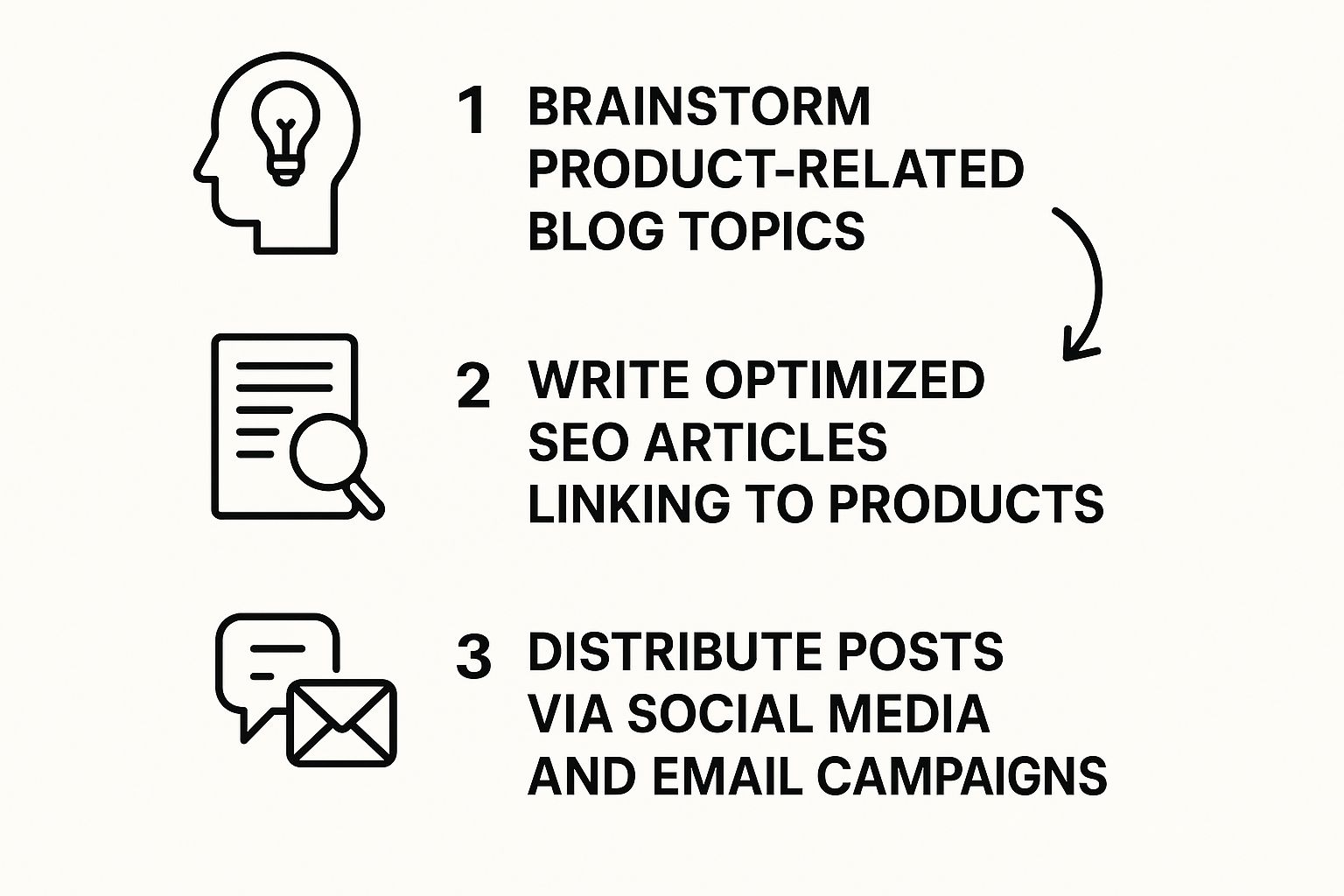
This screenshot from Google’s own docs shows you exactly how to implement it. It’s a crucial tool for controlling what gets indexed on a page-by-page basis.
Now, for some filter combinations that get a decent amount of searches (like “men’s black running shoes”), I might let that specific page be indexed. For all the others, I’ll use canonical tags or a noindex directive to keep them out of Google’s index, which stops duplicate content issues dead in their tracks.
Earning Links and Building Authority

Alright, once I’ve got your on-page and technical SEO in a good place, it’s time to tackle the next big beast: your site’s authority.
Think of it like this: in Google’s world, backlinks from credible, relevant websites are basically votes of confidence. They tell search engines that your shop is a trusted resource, and that’s a huge piece of the puzzle for hitting those top rankings.
My whole philosophy on link building for e-commerce is simple: quality over quantity. I’d take one powerful link from a major industry blog over a hundred dodgy links from random directories any day. The goal is to build a natural, solid backlink profile that actually helps your brand and stands the test of time.
Digital PR for Product Launches
Got a new product coming out? This is a golden opportunity to earn some high-quality links. Instead of just making the product live and hoping for the best, I like to build a mini digital PR campaign around it. This means finding the right bloggers, journalists, and industry websites who would genuinely care about the launch.
I’ll put together a press release that’s more than just a list of features. It needs a story. What problem does this product solve? Is there some cool innovation behind it? Is it made by a local, sustainable brand? Then I’ll personally reach out to my contacts, offering them early access or some exclusive photos. This turns a simple product launch into something newsworthy that naturally gets people talking and linking.
For instance, when a client of mine launched a new line of eco-friendly trainers, we didn’t just email sneaker blogs. We reached out to sustainability and lifestyle publications, pitching the story around the unique recycled materials. We ended up with coverage and links from a much broader and more authoritative group of sites than we ever would have otherwise.
Creating Link-Worthy Content Assets
One of the most sustainable ways I build links is by creating content so genuinely useful that other websites want to link to it. For online shops, buying guides are perfect for this. A really detailed guide not only helps your own customers decide what to buy but also becomes a go-to resource for others in your niche.
I’m not talking about a quick blog post. I’m talking about creating the absolute best guide on the internet for a specific topic. Think “The Ultimate Guide to Choosing a Waterproof Jacket” or “A Beginner’s Guide to Road Cycling Shoes”.
These guides usually include:
- Detailed comparisons of different product types.
- Expert advice on what features really matter.
- High-quality, custom photos and graphics.
- Answers to all the common questions people ask before they buy.
After publishing the guide, I’ll promote it to relevant websites and online communities. Because the content is so helpful, it starts to earn links naturally over time. It’s a strategy that keeps paying off long after the initial work is done.
Leveraging Supplier and Manufacturer Relationships
This is probably one of the easiest and most overlooked link-building tactics out there. Your suppliers and the brands you stock often have a “stockists” or “where to buy” page on their website. A link from a major brand’s official site is a hugely valuable and relevant signal to Google.
I make it a standard part of my process to get in touch with the marketing contact for every supplier. A simple, polite email asking to be added to their stockist page is often all it takes. It’s a quick win that adds highly relevant, authoritative links to your backlink profile with very little effort. If you want to dive deeper into this, check out my ultimate 9-step ecommerce SEO checklist for 2025.
Analysing your competitors’ backlinks is like being given a treasure map. It shows you exactly where they’re getting their best links from, providing you with a ready-made list of high-value targets to pursue for your own site.
Uncovering Opportunities with Competitor Analysis
I regularly fire up tools like Ahrefs’ “Link Intersect” to see what my clients’ top competitors are up to. I look for sites that are linking to two or three of my competitors, but not to me. This is a massive clue – it tells me that website is happy to link to businesses in my niche, and I’ve just been missed off the list.
This process uncovers everything from industry blogs and news sites to product review platforms. Suddenly, I have a super-targeted list of people to reach out to who are already proven to link to stores just like mine. It takes all the guesswork out of link building and lets me focus my energy where it’s most likely to get results.
Your Ecommerce SEO Questions Answered
https://www.youtube.com/embed/C5ddo63kHHI
I’ve covered a lot of ground in this guide, walking through the core strategies I use to build a powerful organic presence. But I know from experience that a few common questions always pop up.
These are the practical, real-world queries I get from ecommerce businesses all the time. Let’s get you some clear, straightforward answers.
How Long Does Ecommerce SEO Take to Show Results?
This is the big one, and the honest answer is always: it depends.
Based on what I’ve seen over the years, you should start noticing some positive initial movement in rankings and traffic within 3 to 6 months. These are the early green shoots—the first signs that your efforts are paying off and things are heading in the right direction.
But for the kind of significant, game-changing results that genuinely move the needle on your bottom line? That typically takes somewhere between 6 to 12 months of consistent, focused work. SEO is a long game. Think of it less like a quick marketing tactic and more like building a valuable digital asset for your business. Factors like your site’s age, how fierce the competition is in your niche, and how hard you push your SEO efforts all play a huge part.
What Is the Single Most Important Part of SEO for an Online Store?
If I had to boil it down, I’d say it’s a tie between a rock-solid technical foundation and excellent on-page optimisation for your category and product pages. It’s a two-part answer because you simply can’t have one without the other.
Think about it: if Google can’t crawl and make sense of your site because of technical glitches, even the most brilliant content won’t get ranked. On the flip side, if your product pages aren’t optimised for the keywords people actually use when they want to buy, all the traffic in the world won’t convert. Nailing these fundamentals has to be your absolute priority before you even think about scaling up things like link building.
A classic mistake I see is businesses pouring money into backlinks for a technically broken website. It’s like trying to fill a bucket riddled with holes—you’ll burn through a lot of effort and cash for very little return. Always fix the foundation first.
Should I Focus on SEO or PPC for My Ecommerce Website?
My advice here is always to do both. I genuinely don’t see this as an “either/or” choice; they work together beautifully.
- PPC (Pay-Per-Click): This is your tool for immediate results. It drives traffic and sales right away, which is crucial for cash flow, testing out new products, and quickly gathering data on what converts.
- SEO (Search Engine Optimisation): This is your long-term investment. It builds sustainable organic traffic that, over time, usually delivers a much higher return and establishes your brand’s authority and trust.
I often use the data from PPC campaigns to sharpen my SEO strategy. For instance, if I spot a high-converting keyword or a piece of ad copy that really resonates with customers, I’ll test that messaging in the meta descriptions for organic search. It creates a powerful feedback loop where each channel makes the other stronger.
How Do I Handle Out-of-Stock Products for SEO?
This is a classic ecommerce headache, but the solution is actually pretty simple. Whatever you do, never, ever delete the page! When you delete a URL, you’re throwing away all the authority and link equity that page has painstakingly built up. It also creates a terrible user experience, dumping visitors on a 404 error page.
Here’s my go-to two-step process:
- Temporarily Out of Stock: Just keep the URL live. Make it crystal clear that the product is out of stock and—this is crucial—give visitors a way to sign up for an email notification when it’s back. This way, you capture a potential future sale instead of losing it completely.
- Permanently Discontinued: If a product is gone for good, the best move is to set up a 301 redirect from that old URL to the most relevant alternative you have. This could be a newer version of the same product or simply its parent category page. This redirect passes most of the link equity over to the new page and ensures shoppers land somewhere useful.
At Mersudin Forbes Digital, my job is to turn these SEO complexities into straightforward, revenue-driving strategies for ecommerce businesses. If you’re ready to build a powerful organic sales channel, explore how I can help.